AI and the Principles of Evolution
Every major technology has promised to make our lives simpler. None of them did. The printing press, electricity, the internet, digitalization: each one was supposed to reduce complexity. Instead, we used every single one of them to build systems of ever higher complexity, pushing ourselves right back to the edge of what we can handle.
AI is no different. Understanding why tells us what will actually change for enterprises, and what will not.
Complexity Fills Available Capacity
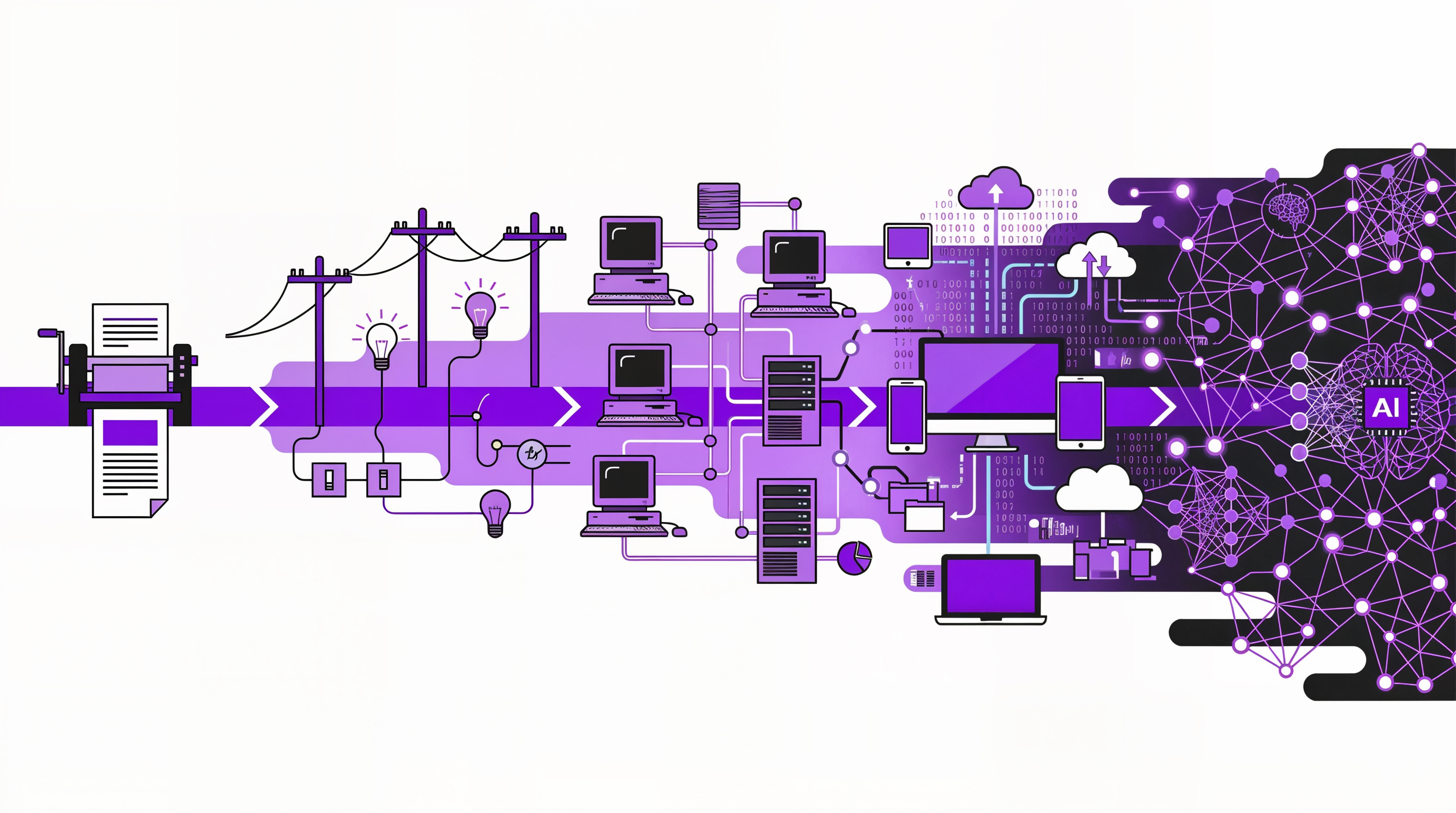
Consider digitalization. Its promise was better, more reliable processes. Less paperwork, fewer errors, faster decisions. Look around any office today: people spend their days filling out spreadsheets, sending emails, managing workflows in tools they can barely keep track of. Digitalization did not reduce bureaucracy. We used it to create more rules, more processes, more administrative structures, because suddenly we could manage them.
This is not a failure of digitalization. It is a law of human systems.
We always operate at the maximum complexity our tools allow.
This pattern has been documented across domains. In 1865, William Stanley Jevons observed that more efficient steam engines led to more coal consumption, not less. The mechanism is the same: when the cost of an action drops, we do more of it.
Before digitalization, we simply could not afford the level of bureaucratic control we have today. We would not have had the capacity to manage it. Digital tools raised the ceiling. We immediately moved in.
The same pattern repeats with AI. We will not use it to simplify our organizations. We will use it to build pharmaceutical research programs of unprecedented complexity, requiring entire Teams of specialists augmented by AI just to keep up with the science. We will use it to create financial products so intricate that no single human mind can fully comprehend them. We will use it to manage supply chains spanning continents with real-time optimization that would have been unthinkable five years ago.
We will use every bit of available AI capacity. Our data centers are already running at full throttle. When we build more, we will fill those too.
Life Creates Higher-Order Systems
This is not just a business pattern. It is a law of nature.
Life, at its core, is a process that takes energy and uses it to create systems of higher order. A cell takes chemical energy and builds a structured organism. A plant takes sunlight and creates complex molecular structures. An ecosystem takes the energy flowing through it and produces ever more intricate webs of interdependence.
Left alone, systems tend toward disorder, toward a uniform distribution of energy. Increasing entropy is a fundamental law of the universe: the second law of thermodynamics.
Life works against this tendency, locally. It takes energy and creates order, structure, complexity. In doing so, life actually increases the total entropy of its environment, releasing waste heat and disorder for every bit of order it builds. The local structure we see around us comes at the cost of greater disorder elsewhere. However, as long as energy flows in, life keeps building upward.
Think of a startup burning through venture capital to build market share. It takes in energy (capital, talent, attention) and creates structure (product, organization, customer relationships). Stop the investment, and the structure dissolves. The startup dies. This is not a metaphor. It is the same thermodynamic process.
Our economy is nothing other than an expression of this same principle. Our organizations, our products, our markets: they are all systems of organized complexity that we maintain through continuous investment of energy. Leadership energy, capital, human effort.
Teams, business units, and enterprises are how humans create higher-order systems. They are the social structures through which we channel energy into organized complexity. This is why maintaining a team costs energy: leadership, coordination, motivation. Stop investing, and the team dissolves. Thermodynamics.
At first, it may seem that evolution is a far-fetched concept to set as the fundamental strategic doctrine for an enterprise. But what is an enterprise? It is a belief system created by humans, who are the product of billions of years of evolution.
Generative Artificial Intelligence is a new technology bridging process knowledge and data, which most enterprises highly depend on. It accelerates evolution by bringing more order into these areas. In other words, it reduces local entropy. This requires energy, which is very close to what we understand life to be.
The fear that AI will “take over” conflates two very different things. Taking over, competing, replacing: these are attributes of life itself. One species outcompeting another. One enterprise displacing a rival. GenAI is not Artificial Life. It does not compete with us. It does not want anything.
But GenAI will become part of our lives. It will become part of how we think, how we organize, how we evolve. Not as a replacement, but as the next tool in a co-evolutionary process that began with fire and has not stopped since.
AI Is Just the Next Evolutionary Step
The history of human progress is a history of co-evolution between humans and their tools. We create tools. The tools extend our reach. We use the extended reach to tackle harder problems. The harder problems require better tools. The cycle continues.
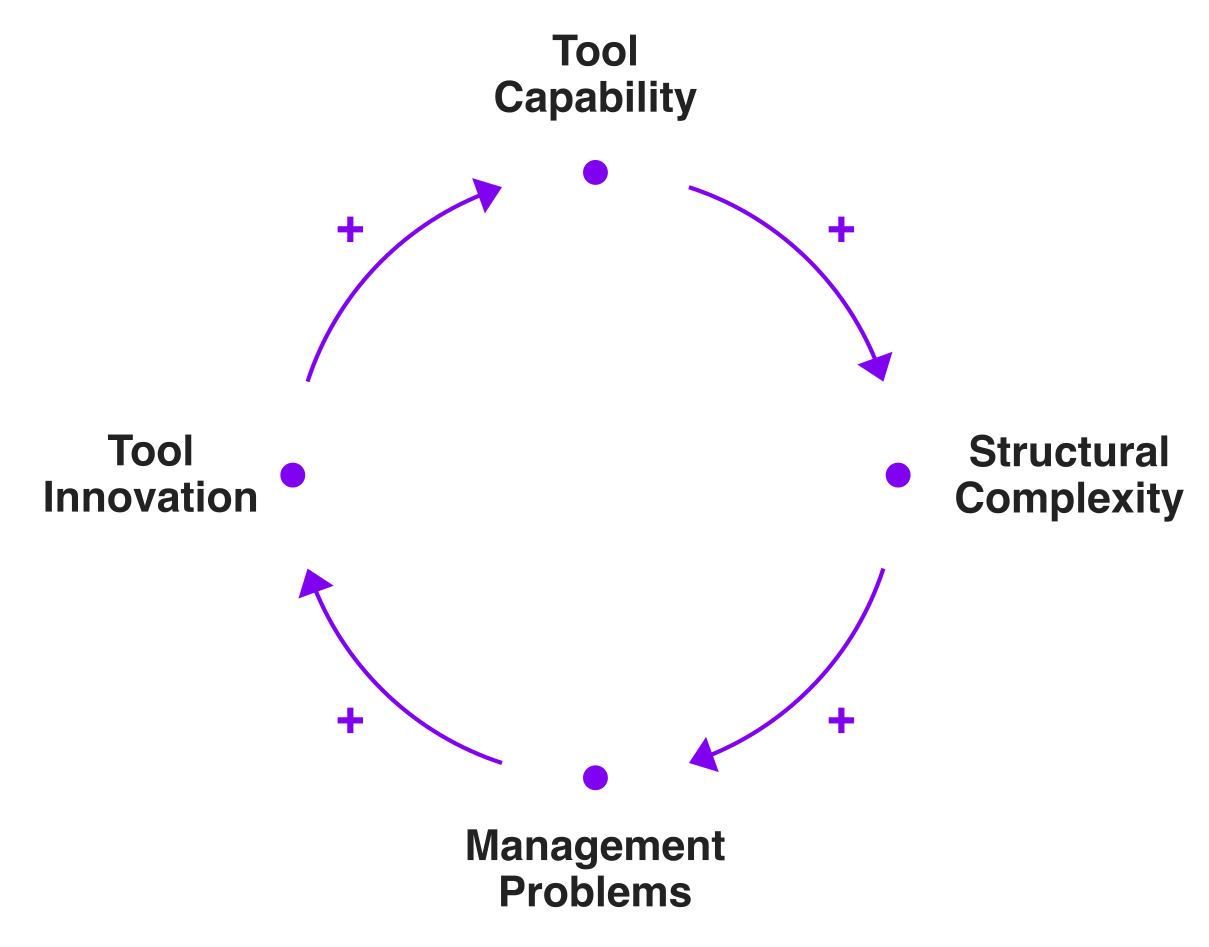
Fire, agriculture, writing, printing, steam engines, electricity, computing, the internet: each of these was an evolutionary step that fundamentally expanded what humans could achieve. Each time, the expansion was not toward simplicity but toward greater complexity. Each time, the social structures of collaboration adapted but did not disappear.
AI is the current step in this sequence. It is a powerful one, certainly. But it follows the same pattern. We are already using AI to develop AI, which is simply the logical continuation of this co-evolutionary process.
AI is not the end of evolution. It is the next chapter.
The question is not whether AI will change how we work. It will. The question is whether it will change the fundamental need for human collaboration. It will not.
AI changes what teams do, not whether teams exist. Every previous tool shift had the same effect. The printing press did not eliminate scriptoria. It transformed them into publishing houses. Steam power did not eliminate workshops. It transformed them into factories. AI will not eliminate teams. It will transform what they take responsibility for.
Social Structures Persist
If you follow the argument so far, you might expect that AI will at least make teams smaller or less necessary. The evidence from every previous technological revolution says otherwise.
The social pattern predates every technology we have ever invented. It will outlast AI too.
The concept of a “team” is deliberately broad in AME3. There is no fixed number. A hospital ward operating in shifts is a team, even though its members rarely see each other all at once. A software development group of seven is a team. An Arena of 200 people can function as a cohesive unit with dynamic sub-structures, containing many teams of different sizes and lifespans within it.
Team size and lifetime depend on the complexity a team navigates. Simpler, well-understood work allows larger groups. Novel, uncertain work demands smaller, tighter collaboration.
What changes is what teams take responsibility for. Teams are evolving from component-focused groups to full-business teams that own end-to-end value chains. AI accelerates this evolution. It does not replace the team itself.
New Products Require Reorganization
There is one dimension where AI’s impact goes beyond previous technological shifts: the sheer speed at which new products and services can emerge. This is the complexity principle at enterprise scale. More products, faster, each requiring its own organizational adaptation.
When AI enables a team to build, test, and deploy a new product in weeks rather than months, the bottleneck shifts from development to organizational adaptation. Your enterprise must be able to absorb new products into its portfolio, spin up new Arenas, restructure value chains, and reallocate resources, all within the strategic cadence of months, not years.
In the Meridian Industries story, a Team used AI to prototype a predictive maintenance service in three Matches. The prototype proved customer value. The Enterprise Owner spun up a new Arena, reassigned domain experts from a shrinking division, and aligned the next Tournament around the opportunity. The product emerged in weeks. The organizational response kept pace because the governance structure was already designed for it.
This is where Evolution Focus becomes critical. Every advancement along the evolution path requires reorganization. This is not dramatic in an AME3 organization. It is standard practice. The flexibility to reorganize is built into the system through Empirical Control and the lean governance structures of the Enterprise.
But make no mistake: the pace of reorganization will increase. Enterprises that treat organizational structure as fixed will fall behind those that treat it as a living system, one that evolves alongside its products and markets.
The Principle
Life creates systems of ever greater complexity as long as energy is available. Humans always push their systems to the maximum complexity their tools allow. AI is the latest and most powerful tool in this sequence, but it follows the same evolutionary pattern as every tool before it.
This means we will keep reinventing our products and services, and keep reorganizing our organizations to deliver them. AI accelerates this cycle, just as every major invention before it did. We will simply reinvent and reorganize faster.
What remains are the fundamental social structures humans need to thrive, to communicate, to think, to organize together toward a shared purpose.
As long as we have energy, we will build. And as long as we build, we will build together.
If complexity always fills available capacity, then AI will fill it too. The question is whether your enterprise uses this capacity to build more bureaucracy, or to strip it away. That is the fork every enterprise faces.