Artificial Intelligence
Studying electrical engineering in the late 1990s was a demanding endeavor. The mathematics alone pushed me to my limits. The ideal of the engineer was clear: calculate precisely how a system behaves before building it. Model it. Predict it. Control it.
Then, in a lab seminar, I watched an experienced practitioner do something that contradicted everything I had learned. He was tasked with tuning a control system. Instead of setting up the differential equations that describe the system’s dynamics, he fed a Dirac impulse into the system and observed what came out.
A Dirac impulse is an idealized, infinitely short signal. Feed it into a system, and the response gives you hints about its internal dynamics, if you have the experience to read them: how fast the system reacts, whether it oscillates, where it stabilizes. It is the engineer’s empirical shortcut. Instead of predicting the system from theory, you probe it and observe.
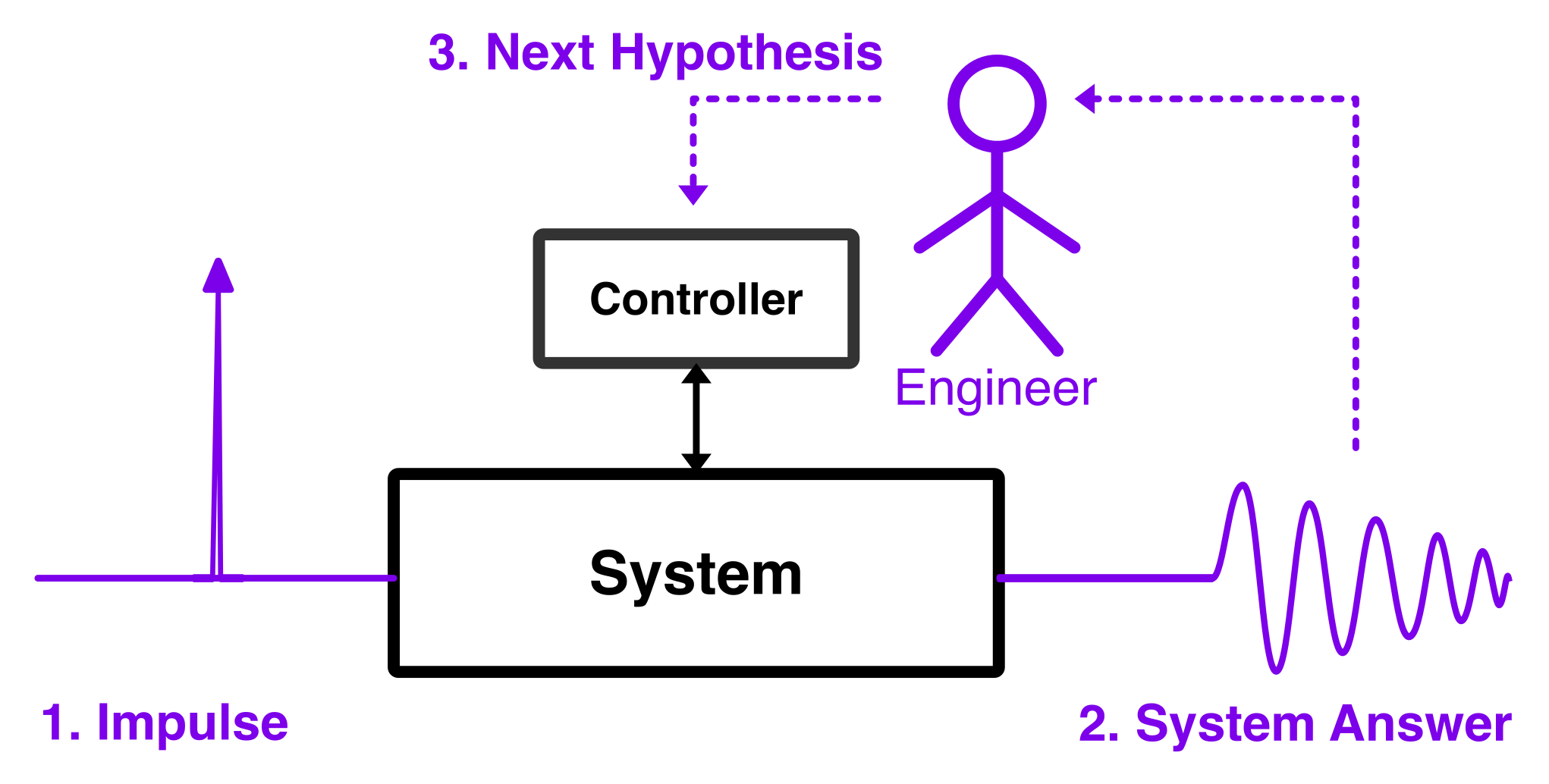
From the impulse response, the practitioner drew conclusions about the system’s behavior. Based on experience and pattern recognition, he adjusted the controller. No differential equations. Just: stimulate, observe, adjust. Repeat.
In analog engineering, where systems are inherently non-deterministic, this was standard practice. A theoretical model exists, but in practice you proceed empirically. The theory told you the direction. The practice told you the truth.
Around the same time, one of my professors at TU Darmstadt captured my attention with a very different technology. Wolfgang Hilberg was an engineer of the old school, best known for his pioneering work on the radio-controlled clock. With 45 patents to his name, his roots ran deep in analog electronics. But while everyone else celebrated the great shift from analog to digital, Hilberg swam against the current. He pursued analog neural networks and later published on artificial cognition.
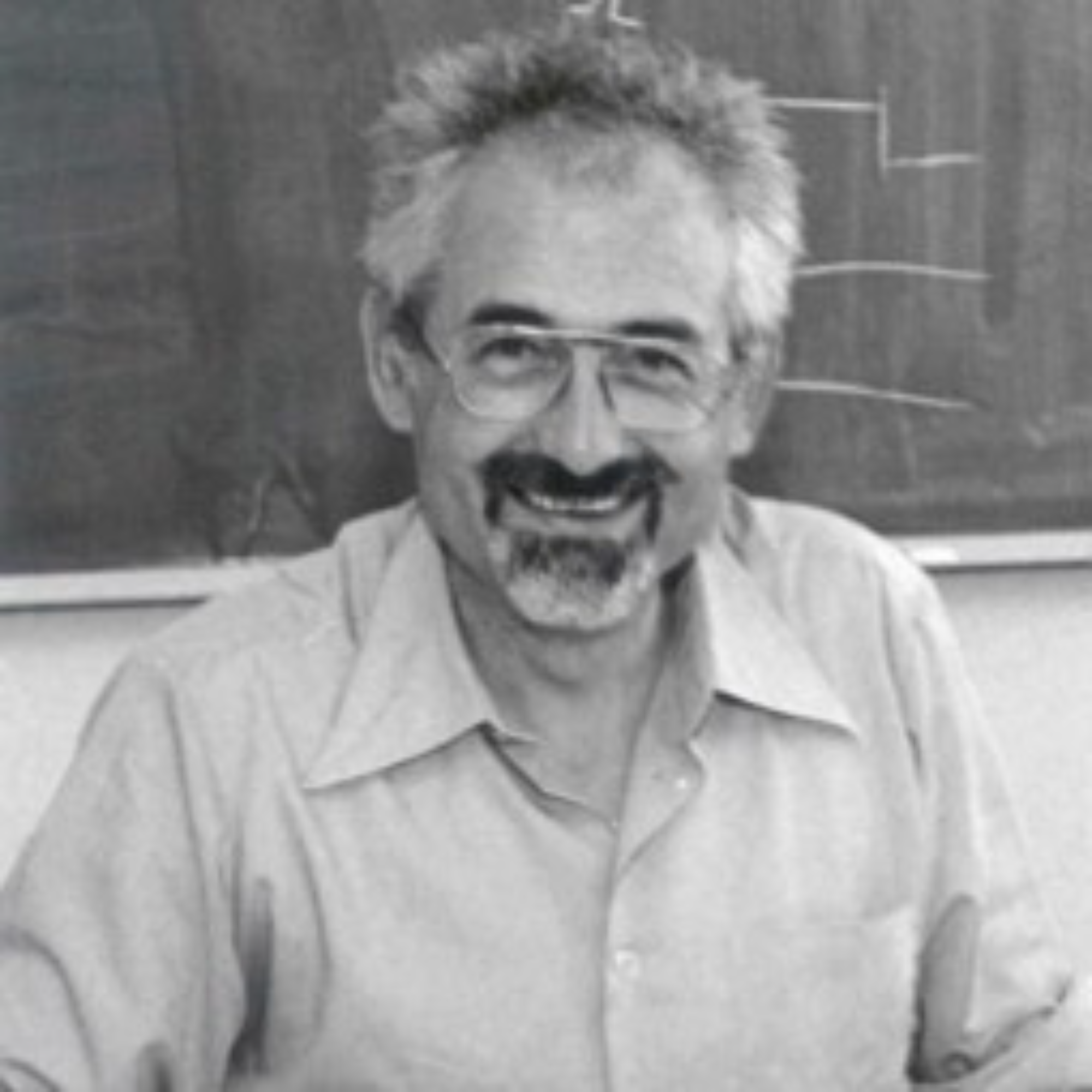
The late 1990s were the era of the great shift from analog to digital. The promise was seductive: imprecise, fuzzy analog technology replaced by precise, mathematically deterministic digital technology. I could already experiment with neural networks on a PC. I had a software simulator with, if I remember correctly, fewer than 100 parameters, the adjustable numbers that define a neural network’s behavior. It was an interesting academic exercise. Impressive as a demonstration. Useless for anything serious. I dismissed neural networks entirely, like most people did.
Until the day I first used ChatGPT.
How We Got Here
The history of AI follows a pattern: promise, overinvestment, disappointment, quiet survival of the core ideas. Symbolic AI (1950s-1980s) tried to encode intelligence as rules and failed on real-world complexity. Expert Systems (1980s) encoded specialist knowledge but were brittle and could not learn. Two AI winters followed.
The quiet revolution came through machine learning: algorithms that improve through experience. Neural networks had existed since the 1940s but remained small. In 2017, the Transformer architecture processed entire sequences in parallel, the breakthrough behind modern Large Language Models. The jump from my 1990s simulator with fewer than 100 parameters to GPT-3’s 175 billion is not just quantitative. Somewhere along this scale, emergent capabilities appeared: abilities the developers did not predict or program. Then came reasoning models that think step by step, and agents that act autonomously.
What changed between the 1990s and the 2020s?
The Enablers
The answer is not a single invention. It is a stack of enablers that matured simultaneously.
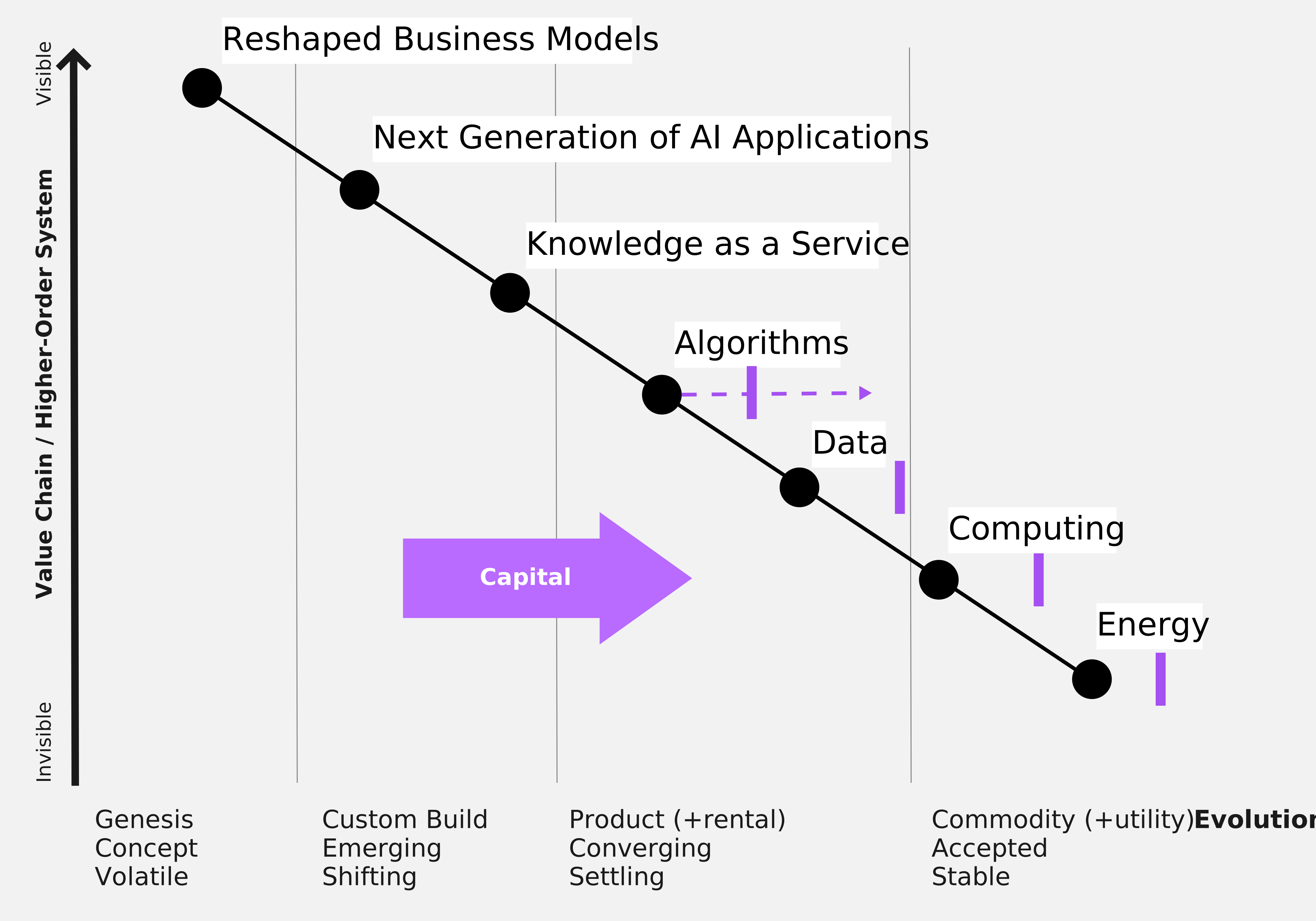
The map tells the story. At the bottom, the most fundamental layers. Energy is a commodity: the power grid, data center infrastructure. Without it, nothing runs. Computing has moved from expensive custom hardware to commodity cloud services. GPU clusters that once required million-dollar investments are now available on demand.
Data sits at the product stage. The internet produced training data of unprecedented scale. Decades of human text, code, and conversation became the raw material. But data is still evolving: questions of quality, bias, and access remain open.
Algorithms are products, rapidly evolving. The Transformer architecture (2017) provided the engine. Techniques like reinforcement learning from human feedback refined it. New approaches like reasoning and chain-of-thought prompting continue to push the frontier.
Capital is the accelerator. Billions of dollars in investment fund the training runs that turn these ingredients into working models. Capital pushes every component further along the evolution path.
Above these enablers, the higher layers are still emerging. Knowledge as a Service, next-generation AI applications, and reshaped business models sit in Genesis and Custom Build. They are volatile, uncertain, full of opportunity. This is where the competitive landscape is being drawn right now.
The key insight: only when lower layers mature can higher layers emerge. This is Evolution Focus in action. Each evolutionary stage enables the one above it. Developing a Strategy for the GenAI Era explores this map in depth and shows how to use it for your enterprise.
Professor Hilberg’s vision was right in direction, wrong in timing: the enablers were not ready. Today, researchers are pursuing programmable photonic hardware that implements neural network functions directly in optical circuits. Precisely the kind of analog AI that Hilberg envisioned decades ago.
The enablers explain why AI is happening now. But what is actually happening inside these systems?
How It Actually Works
For the reader who wants to understand the technology, not just its consequences: here is how a Large Language Model works, in the simplest terms possible.
A neural network is a web of interconnected numbers called parameters. During training, data flows through the network, and an algorithm called backpropagation adjusts the parameters based on errors. Think of it as: “the output was wrong, so let me tweak the numbers that produced it.” Repeat this billions of times with billions of data points, and the network starts recognizing patterns that no human programmed into it. Grant Sanderson’s Neural Networks by 3Blue1Brown video series provides an intuitive visual introduction to this process.
The Transformer is a specific architecture for neural networks. Instead of processing input one piece at a time, it processes entire sequences in parallel. A mechanism called “attention” lets the model determine which parts of the input matter for each part of the output. This is what makes Large Language Models possible at scale. Jay Alammar’s The Illustrated Transformer walks through the architecture step by step.
An LLM is a massive Transformer network trained on vast amounts of text. It does not look up answers. It predicts the most likely next word, informed by patterns learned from billions of examples. At sufficient scale, emergent capabilities appear. The model can write code, draft legal contracts, explain quantum mechanics, and hold conversations. None of these were explicitly programmed. Intro to Large Language Models by Andrej Karpathy offers an accessible one-hour overview.
At the same time, Diffusion Models did for images what LLMs did for text: generate new content from learned patterns by gradually refining random noise into coherent visual output. Like LLMs, diffusion models demonstrate that pattern recognition at scale produces capabilities nobody explicitly programmed.
Both types of model share a fundamental property: they are non-deterministic. Ask the same question twice, get two different answers. Not because they are broken, but because that is how they work.
The Return of the Non-Deterministic
Now the arc comes full circle.
The engineer with the analog control system worked empirically. He did not compute the differential equations. He probed the system, observed the response, and adjusted. This was standard practice in analog engineering, because analog systems are inherently non-deterministic. Temperature fluctuations, manufacturing tolerances, material variations: the same circuit never behaves exactly the same way twice.
The great promise of digitalization was to leave this behind. Digital technology is precise. Deterministic. Repeatable. The same input always produces the same output. Strictly speaking, this was never entirely true. But the belief was strong, and for most practical purposes it held.
Now we work with a technology that is fundamentally non-deterministic again. As Tudor Girba and Simon Wardley describe in Rewilding Software Engineering, a Large Language Model is “a coherence engine, not a truth engine. It does not give you what is, but what is likely and sounds coherent.”
This is not a flaw. It is the nature of the technology. Critics argue this unpredictability makes AI unreliable for high-stakes decisions. They are right to demand guardrails. But the response is not to force determinism where none exists. It is to work empirically.
And it is strikingly familiar. We humans never think a thought exactly the same way twice. We never make the same decision the same way twice, because we have gained new experience or our environment has shifted. Just as the environment of a control system changes: temperature, component aging, external disturbances. The analog engineers understood this. They worked empirically because they had to.
The AI era demands the same.
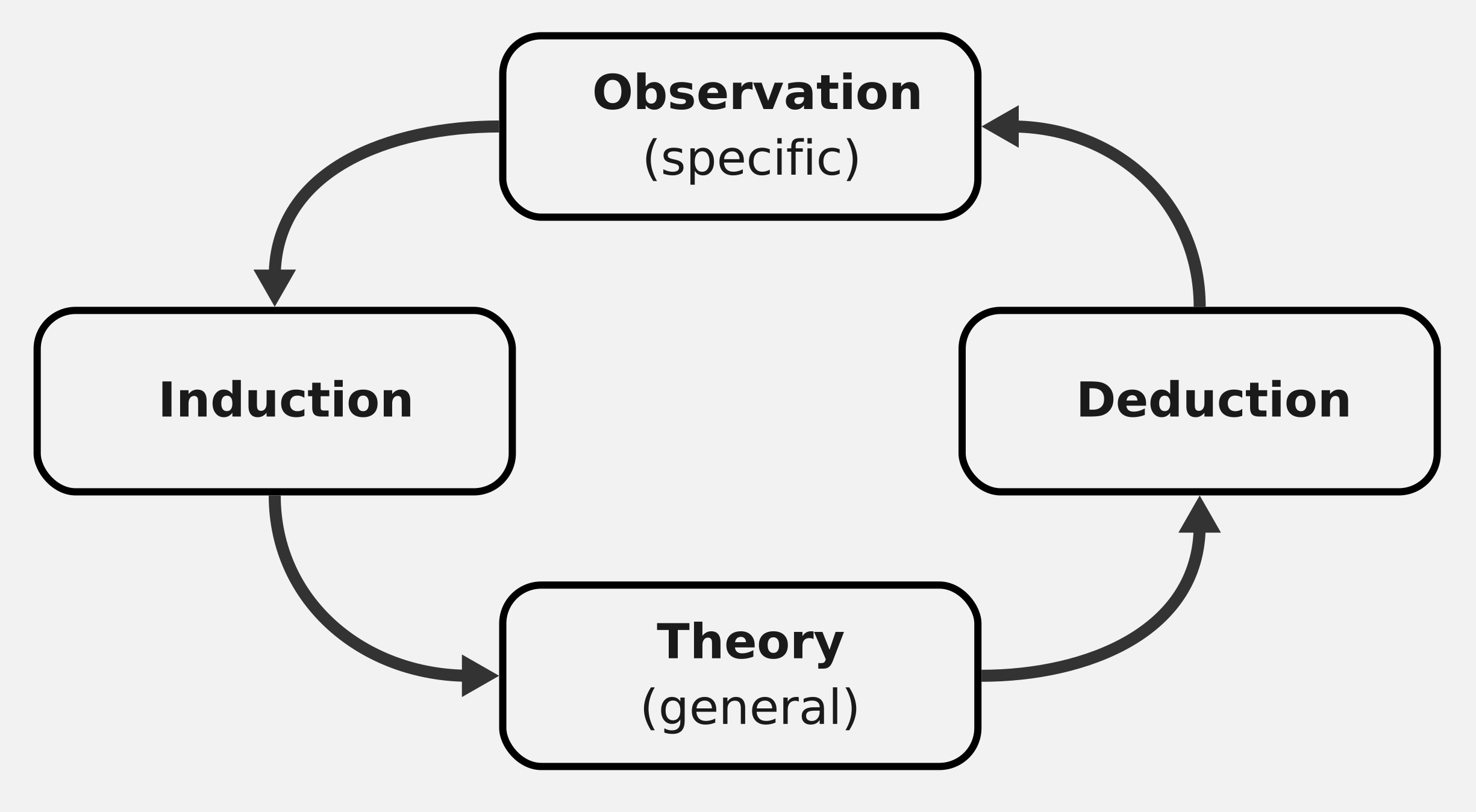
Deduction works top-down: from a general theory to a specific prediction. If the premises are correct, the conclusion is guaranteed. This is the promise of deterministic systems.
Induction works bottom-up: from specific observations to general patterns. The conclusions are probable, not certain. This is how we learn from experience.
Empiricism combines both in a continuous loop. Observe the system. Induce a pattern from what you see. Form a theory. Deduce a prediction. Test it against reality. Observe again. This is the scientific method. It is also the AAA-Loop at the heart of AME3: Anticipate, Advance, Assess.
AI makes induction central again. You cannot deduce the correct output of an LLM from theory alone. You must observe what it produces, recognize patterns in its behavior, form hypotheses about when it works well and when it does not, test those hypotheses, and refine your approach.
Hilberg saw the direction. The timing was wrong. The enablers were not ready. But the insight was right: intelligence, whether human or artificial, does not follow the deterministic model that digital technology promised. It follows the empirical model that engineers have used for centuries.
The game is empirical. It always was.
What Comes Next
AME3 structures leadership, strategy, and rules. The Playbook shows how to get started. Now comes the question every enterprise faces: what does AI actually change for us?
AI and the Principles of Evolution starts with why complexity always grows, why Teams persist through every technological revolution, and why the pace of reorganization is accelerating. AI Will Not Fix Your Bureaucracy confronts the most common mistake: using AI to amplify the very structures that should be questioned. Every enterprise faces this fork.
From there, the focus shifts to action. Developing a Strategy for the GenAI Era gives you practical tools for mapping your strategic terrain using Wardley Mapping and asks the questions your enterprise needs to answer about customers, data, skills, and process knowledge. The AI-Enhanced Team of the Future traces how teams are evolving from component groups to full-business units that own end-to-end value chains. Interplay/AI/The End of Software as We Know It argues that the way we interact with software is inverting, from human-driven to machine-initiated, and explores what this means for products and services far beyond the software industry.
AI Agents in Practice Beyond Coding closes the section with proof: what an AI-enhanced work system looks like in daily practice today. Not as a vision, but as a working architecture behind this book.
The principles in these chapters apply beyond AI. They apply to any technology that accelerates evolution. The Methods section that follows explores the practical frameworks that bring them to life.
AI and the Principles of Evolution
Why AI follows the same evolutionary pattern as every tool before it. Complexity always grows, teams persist, energy drives it all.
Explore the evolution principleAI Will Not Fix Your Bureaucracy
AI will not automatically reduce bureaucracy. Enterprises face two paths: simplify or amplify. Only conscious leadership chooses wisely.
Rethink AI and bureaucracyDeveloping a Strategy for the GenAI Era
Use Wardley Mapping to assess your GenAI terrain, ask the right strategic questions, and advance with empirical control.
Develop your GenAI strategyThe AI-Enhanced Team of the Future
How development teams evolve from component groups to AI-enhanced full-business teams that own end-to-end value chains.
Explore AI-enhanced teamsThe End of Software as We Know It
Six paradigms trace how software shifted from human-operated to machine-initiated. The final stage inverts who acts first.
Explore the software inversionAI Agents in Practice Beyond Coding
The AI architecture behind this book. How Obsidian, Claude Code, and 50+ skills power consulting, publishing, and knowledge work.
Explore the architecture