Developing a Strategy for the GenAI Era
Do you remember Netscape? In 1996, they controlled nearly 80% of the web-browser market. Today, users are starting to forget what a browser is, simply because browser engines are part of our daily lives and deeply embedded in many of the devices we use.
What started as an entirely novel concept in 1989 has become a commodity today. As you read this, you are most likely looking at a Chromium, WebKit, or Gecko engine. Browser engines, as a fundamental component of the World Wide Web, have reshaped nearly every business and the way we handle knowledge today. The most valuable enterprises today would not exist without them.
This is evolution.
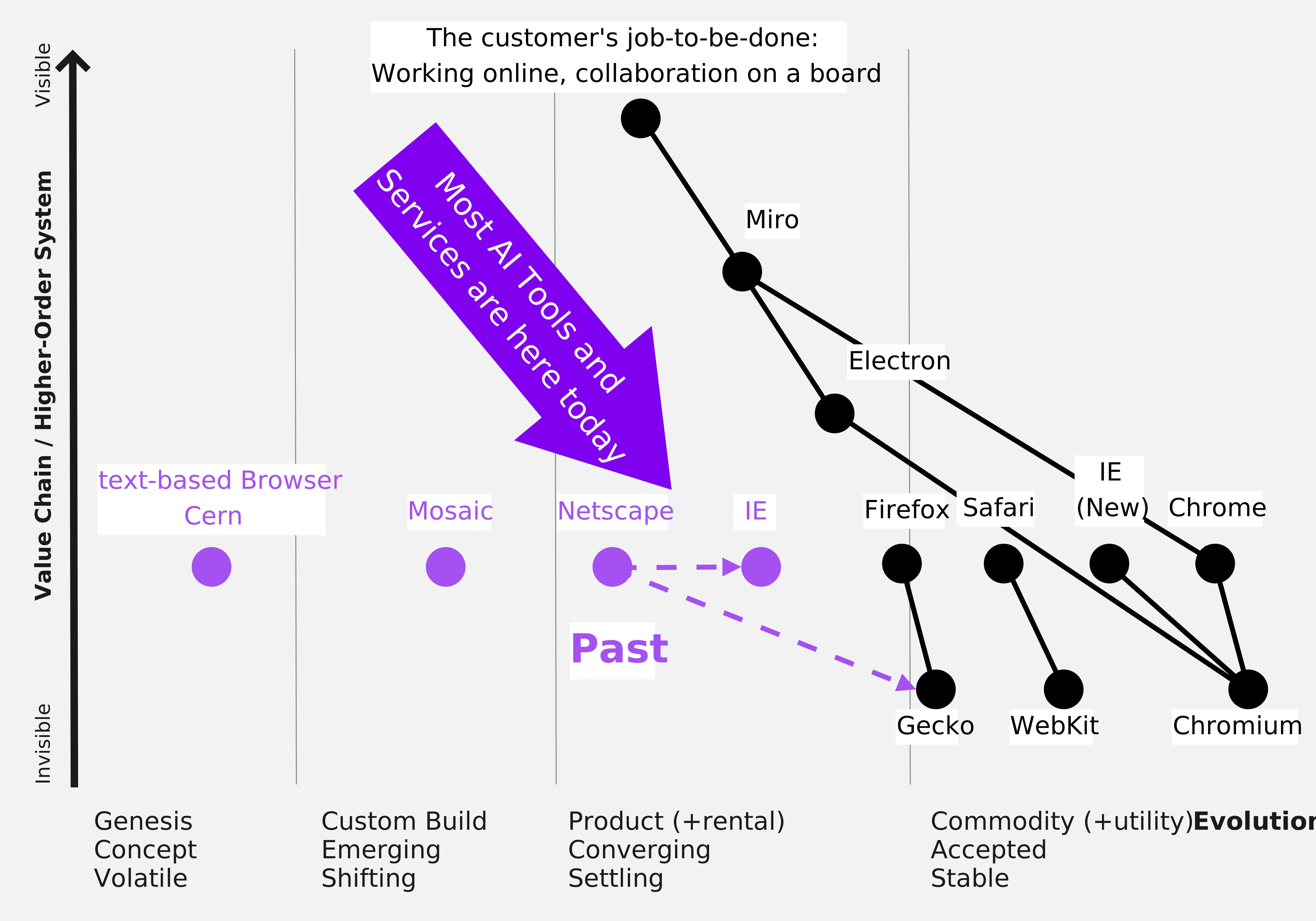
GenAI will follow a similar path. Like browsers, GenAI begins as a novel capability but will inevitably commoditize: first its infrastructure (chips, models), then its applications (agents, interfaces). Competition demands this. But even though we know that the impact of GenAI will be as large as that of the World Wide Web, we cannot foresee with certainty how it will change our business and life. We are at roughly the same stage in product evolution as we were with the Mosaic browser in the 1990s. We are just starting to understand what is possible.
But what we can do now is develop a strategy for this uncertainty and new upcoming opportunities to prepare your enterprise for the GenAI era. The overarching strategic doctrine for an enterprise should be Evolution Focus.
In early 2025, I came across one of many illustrations showcasing a vast array of tools and services related to GenAI, from big names like OpenAI to fundamental services like Hugging Face. At the time, players like DeepSeek had not yet emerged. Overviews like these change rapidly.
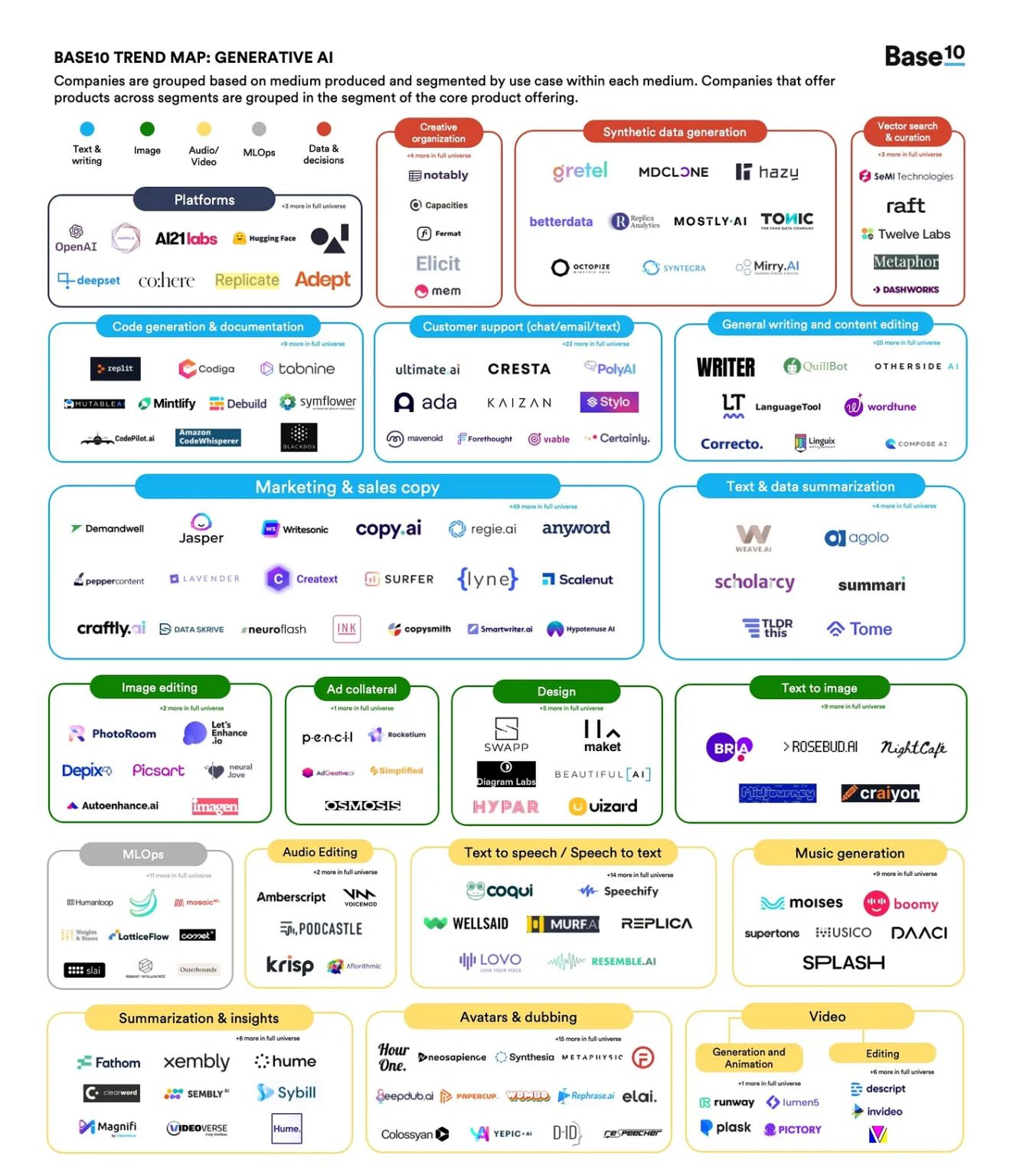
It is likely that in five years, many of these names will fade from memory, much like Netscape. Other significant players of the future are probably not yet visible in the current landscape. But assessing your terrain of business in the context of GenAI tools and practices seems like a good place to start.
Unfortunately, illustrations that merely list the numerous GenAI tools in the market are entirely useless for making strategic decisions for your business. We need a map that sets your organization, product, and services in the context of evolution and the GenAI market.
Simon Wardley created an excellent mapping technique specifically for this purpose. The technique applies to any strategic question, not just AI. We use GenAI as the lens here because it is one of the most urgent forces reshaping enterprises today. The map of the evolution of web browsers I showed before is such a Wardley Map.
A Wardley Map has two dimensions. The horizontal axis shows evolution: from Genesis (novel, unexplored) through Custom Built (understood but bespoke) to Product (available off the shelf, sometimes rented) and Commodity (standardized utility). The vertical axis shows the value chain: higher components, such as user-facing services and tools, depend on lower, more fundamental ones. For example, the application framework Electron sits above the browser engine it relies on.
Assess the Terrain
Here is my current perspective on the GenAI market and its potential forces. It is necessarily incomplete, but it illustrates the approach.
It is now easy to see why Nvidia has become so valuable. Their chips are products they can sell per piece, and everyone depends on them. Even the hyperscalers like Google, Amazon, and Microsoft still need to buy them. Patents, specialized knowledge, and the fact that the model architectures have been optimized for the unique chip designs are preventing competitors from keeping up with Nvidia.
However, we will see how long this advantage lasts. Nvidia’s dominance mirrors Levi’s in the Gold Rush: both exploited a temporary bottleneck in a commoditizing market. Optimized chip design for GenAI is a candidate to become a commodity soon.
It is also easy to see that GenAI models are the fundamental component driving the tech giants’ push toward commodity. That is why smaller companies and research institutes in particular release their models as open-weight models (which are not entirely open source, because the training data and the training algorithms remain closed).
Still, GenAI models in general are far from being commodities. As the rise of DeepSeek has shown, new approaches such as reasoning-focused training are creating competition and opening potential for entirely new, higher-level services to customers. Now think about how everything would change if a highly optimized photonic chip, the kind recent research on photonic hardware demonstrates, moved into the GenAI landscape. There is also a strategy behind why OpenAI acquired Jony Ive, the former chief designer of Apple. The next competitive battleground may not be model performance but user experience.
The Question about Everything
My map of the GenAI market still poses several challenges:
- It is probably missing relevant practices, tools, models, and players you should be considering.
- It completely lacks your customer, product, and service.
- Entire industries are not considered: e.g., medicine development, agriculture, robotics.
No single map answers everything. If you want the answer to the question about the universe, life, and everything, you get 42. For a more profound understanding of your terrain, you need to define the questions you would like to be answered.
The following map places a generic business model against the GenAI landscape.
This is not your map. Even if you are familiar with Wardley Maps, you probably do not understand my intention and thoughts behind it. I discover new connections and insights every time I revisit and update it.
The true value emerges when creating maps collaboratively with others. While maps are inherently incomplete, they abstract connections within a system, enabling effective discussions.
Fortunately, we can extract specific questions from the map. I have organized them into a map again.
I structured the map into four rows along the value chain. The rows are not strict categories, just a reading order, and you may find a layering that fits your business better. What matters is that you read the matrix in two directions.
The rows are a value chain. Customers and the experiences they want sit at the top. The skills, people, and organization that make those experiences possible sit at the bottom. In between, process knowledge turns capabilities into products, and data and architecture turn observations into knowledge. A blind spot in a lower row eventually breaks every row above it. You cannot deliver an AI-native customer experience on data you do not yet own.
The columns are evolution stages, and they are not interchangeable. The same topic asks a different question at Genesis than at Commodity. On the left, the question is “what is even possible?” On the right, the question is “what should we stop building ourselves?” Workshops that mix the two end in confusion. Teams argue over hiring plans for capabilities that do not yet exist, or invent new products in spaces that have already commoditized. The value of the matrix is that it forces the question to match the stage.
How to use it. Pick the cell where you feel most blind, not the one where you feel most comfortable. The interesting answers usually live in the row you instinctively skip. CEOs skip Skills, People, and Organization. CTOs skip Consumer & Customer needs. CFOs skip Genesis entirely. Yes, these are lazy caricatures, and you almost certainly just bristled at the one that fits. That bristle is the point. Whichever cell makes you uncomfortable is probably the cell that holds your next strategic move.
The two examples that follow show this in practice. The automotive supplier opened the matrix in Data and Architecture and discovered their strategy was bottlenecked by what they could see, not what they could build. DasScrumTeam opened it at the top, in Consumer & Customer needs, and found an entire market commoditizing underneath them. Different cells, different answers, the same matrix.
Example 1: Automotive Supplier
In this example, a supplier in the automotive industry wanted to understand how they could make the evaluation step in the order process more efficient and meaningful.
Looking at the map, it becomes clear that everything depends heavily on the data they have. Some data sources are external and not yet structured. A first strategic goal could be to experiment and gather some data sources into datasets that an AI agent can use.
Increasing efficiency and the quality of services is what most businesses focus on first when they bring GenAI into focus. The reason might be that this is quite obvious, as the example shows. Even though this is not a bad optimization goal, it could be a short-sighted decision because you might miss some important aspects of the market.
Example 2: Market Transformation for Scrum Training Driven by GenAI
DasScrumTeam AG is the training and consulting boutique that Andy and I run together. It specializes in helping organizations use Scrum to improve their product development. What sets DasScrumTeam apart is that it combines deep Agile experience with the expertise to conduct in-person training. The company itself has been operating as a single Scrum Team since 2010: one Arena Product, one Arena Backlog, one shared Goal.
The question: how will GenAI impact the market for DasScrumTeam? The company is small and does not intend to scale. The conclusion: most of its market will soon be taken over by highly scalable training institutes like the International University. This was inevitable, but GenAI has accelerated the timeline dramatically. For example, Duolingo doubled the amount of online classes with GenAI in one year. Before that, it took them ten years for the same amount.
A natural question arises: if this was inevitable, why did the Product Owner not act five years ago? He saw it coming but did not take action. He did not expect the shift to happen so quickly, and the company was very successful with what they were doing. I know that because I was the Product Owner at this time, which in a one-Team company is the Arena Owner. Simon Wardley calls this pattern inertia. Thankfully, Andy has now taken over this role.
However, plenty of opportunities remain on the left side of the map, in the Genesis and Custom Built space, which is exactly where a boutique firm should focus. High-touch, high-trust services in domains where scalable training cannot compete. This is exactly where Andy and I, as the Accountable Representatives of DasScrumTeam, set our strategic focus. This book is one result of that decision.
Reading the Map
A map shows the terrain. To anticipate what happens next, you need to understand the forces acting on it. Simon Wardley calls these forces Climatic Patterns: recurring dynamics that shape how components evolve, regardless of your actions. They are the weather on your strategic landscape. You cannot control them, but you can prepare for them.
There are 28 documented Climatic Patterns. Five of them are already visible in the examples above.
Everything evolves through supply and demand competition. The Netscape story illustrates this directly. Browsers went from Genesis to Commodity. GenAI will follow the same path. Competition drives infrastructure, chips and models, toward commodity first. Applications and agents follow. The question is not whether this will happen, but how fast.
Capital flows to new areas of value. Nvidia’s dominance mirrors Levi’s in the Gold Rush: both exploited a temporary bottleneck in a commoditizing market. As chips commoditize, capital will flow to the next area of value: applications, agents, user experience. OpenAI acquiring Jony Ive, the former chief designer of Apple, signals exactly this shift.
Characteristics change as components evolve. The automotive supplier focused on efficiency, a Product-stage optimization. That is not wrong, but it risks missing Genesis-stage opportunities on the left side of the map. What works for optimizing an existing process is wrong for exploring a new one. Different evolutionary stages demand different methods, which is why Evolution Focus is a strategic doctrine, not just a mapping exercise.
Success breeds inertia. I saw the shift coming for DasScrumTeam but did not act. Past success made the status quo feel safe. Wardley calls this inertia: the more successful the past model, the stronger the resistance to change. This pattern is invisible on the map itself. It lives in the heads of the people reading it.
Efficiency enables innovation. Duolingo doubled its course offering in one year with GenAI. Before that, the same growth took a decade. The efficiency gain did not reduce effort. It enabled innovation at a scale that was previously impossible. The Jevons Paradox is at work: lower cost per action leads to more actions, not fewer. This is also why AI will not fix your bureaucracy unless you consciously choose to simplify.
These five patterns are not predictions. They are forces already acting on your map. When you revisit your map in the next Tournament, look for them. Where is competition driving commoditization? Where is capital flowing? Where is inertia hiding? The patterns do not tell you what to do. They tell you what to watch.
What Comes Next
As the examples have shown, assessing your terrain by mapping the evolving GenAI landscape is only the first step. By asking the right questions, visualizing your position, and reading the Climatic Patterns, you create a strong foundation for strategic decision-making. But mapping alone is not enough. You need to anticipate, advance, and assess repeatedly to adapt your strategy as the landscape shifts.
The map shows you where to invest. But who does the work, and how does the work change when AI agents execute alongside humans? The next chapter traces how teams are evolving from component groups to full-business units that own end-to-end value chains. AI does not just change what you build. It changes who builds it.