The Estuarine Framework
The Estuarine Framework is the third major framework in the Cynefin ecosystem, developed by Dave Snowden. It provides a model for understanding the forces that shape an organization: constraints, constructors, and actors. It identifies where small interventions can shift the system.
Estuarine Mapping is the facilitation method used to apply the framework. In a structured workshop, participants identify the forces at play, place them on an energy/time grid, and design interventions. The map is the output. The framework is the thinking behind it.
The Estuarine Framework complements AME3’s Empirical Control and Evolution Focus doctrines. Where Wardley Mapping reveals the competitive landscape and direction of evolution, the Estuarine Framework reveals the internal and external forces that enable or resist change. Combined, they give an Enterprise both a strategic compass and a constraint map.
The Estuary Metaphor
An estuary is where river meets sea. The water flows in and flows out. Some elements are stable like a granite cliff, checked rarely. Others, like sandbanks, shift daily. As the tide turns, some elements become visible or disappear entirely.
This metaphor captures how organizations actually work: multiple flows of possibility, not a single linear path. Some things you can only change at the right moment. Some forces are visible, others hidden. And the landscape shifts constantly.
Four Types of Estuaries, Four Types of Organizations
Geologists classify estuaries into four types based on how they formed. Each type maps to a recognizable organizational pattern:
| Estuary Type | Formation | Organizational Analogue |
|---|---|---|
| Coastal Plain (Drowned River Valley) | Rising sea levels flood existing river valleys. Wide, shallow, open to the sea. Examples: Chesapeake Bay, Delaware Bay | Legacy enterprises absorbing market change. The existing structure (the river valley) was built for a different era. Now external forces (rising waters) have flooded it. The old channels still shape the flow, but the landscape has fundamentally changed. Most large enterprises undergoing digital or GenAI transformation are coastal plain organizations. |
| Bar-Built (Restricted Mouth) | Ocean waves build sandbars or barrier islands, creating sheltered lagoons behind them. Water exchange with the ocean is limited. Examples: Pamlico Sound, Matagorda Bay | Protected organizations with restricted market exposure. Internal IT departments, regulated monopolies, or government agencies. A barrier (regulation, captive customers, funding model) shields them from the full force of market dynamics. Calm inside, but also stagnant. Heavy rains (crises, political pressure) can break through the barrier and force sudden change. |
| Tectonic | Crustal movement causes land to sink, creating new basins that fill with seawater. Examples: San Francisco Bay | Organizations disrupted by structural shifts. A tectonic event, such as a merger, a market collapse, or a new technology like GenAI, creates an entirely new basin. The old terrain has sunk. Fresh water (internal capability) and seawater (external demands) mix in a space that did not exist before. Startups in new markets and post-merger organizations are tectonic estuaries. |
| Fjord | Glaciers carve deep, narrow channels. When the glacier retreats, seawater fills the valley. Deep water, narrow mouth, limited exchange. Examples: Puget Sound, Glacier Bay | Deep-expertise organizations with narrow interfaces. Research institutions, specialized engineering firms, or niche consultancies. Deep knowledge (deep water), steep walls of expertise, but a narrow sill at the mouth limits how much outside influence gets in. The bottom can become stagnant and anoxic: brilliant capability that never reaches the market. |
Understanding which type of estuary your organization resembles helps you choose where to focus your mapping. A coastal plain organization has different constraints than a fjord. A bar-built organization will respond to different interventions than a tectonic one.
Core Concepts
The Estuarine Framework works with three types of actants: the forces that shape a system.
Constraints
Constraints shape systems and affect patterns. They are not merely barriers. A constraint can enable, govern, connect, or contain.
| Type | Description |
|---|---|
| Governing | Laws, rules, codes; provide stability but are sensitive to change |
| Enabling | Heuristics and principles; allow distributed decision-making |
| Connecting | Flexible, adaptive structures; links across boundaries |
| Containing | Clear boundaries: departments, categories, defined scope |
| Rigid | Resist change until breaking point: deadlines, compliance requirements |
| Dark | Effect visible, cause unknown: hidden cultural forces |
Constructors
Constructors produce consistent, replicable transformations. They change things that pass through them. A hiring process, an onboarding program, or a deployment pipeline are constructors. They transform through:
- Passage: things change by moving through the constructor
- Contagion: things change by proximity to the constructor
- Presence: things change simply because the constructor exists
Actors
Actors are individuals, roles, collectives, or entities with intelligence and intention. They are the people and groups who act within and upon the system.
The Energy/Time Grid
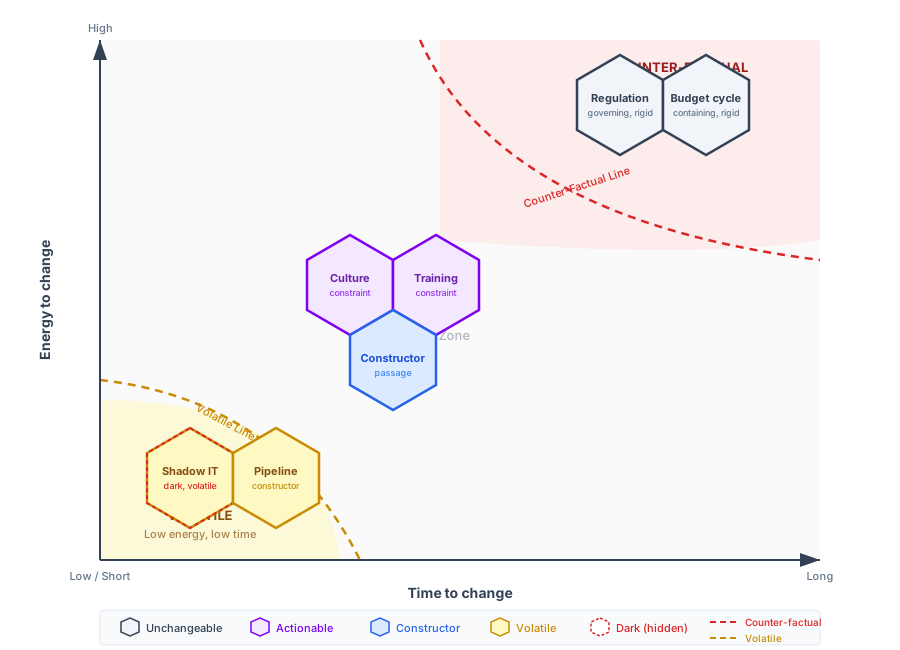
During an Estuarine Mapping workshop, all actants are placed on a two-axis grid:
- Energy (vertical): How much effort, resources, or political capital is required to change this actant?
- Time (horizontal): How long would it take to change it?
This creates a landscape where the position of each actant tells you something about where change is feasible and where it is not.
The Two Lines
Two lines are drawn on the grid to separate distinct zones:
The Counter-Factual Line separates the top-right corner from the rest. Everything above this line is, for practical purposes, currently unchangeable. These are the granite cliffs. You work around them, not against them.
The Volatile Line isolates the bottom-left corner: actants that require very little energy and time to change. These are the sandbanks. They can shift quickly, which means both opportunity and risk. Low cost of change does not mean low impact.
Estuarine Mapping: The Seven Steps
The mapping process follows a pre-process step and seven numbered steps. Steps 0–4 build the map. Steps 5–7 turn it into action.
| Step | Activity |
|---|---|
| 0 | Pre-process: Define the question. Collect material: anecdotes, observations, data |
| 1 | Identify actants: Brainstorm constraints, constructors, and actors. Explore hidden (“dark”) actants |
| 2 | Map on energy/time grid: Place actants, cluster similar items |
| 3 | Draw the counter-factual line: Separate what cannot practically be changed |
| 4 | Draw the volatile line: Identify low-energy, low-time actants and assess their impact |
| 5 | Design interventions: Generate safe-to-fail experiments using the action categories |
| 6 | Set direction of travel: Establish monitoring systems and review cadence |
| 7 | Combine into portfolios: Aggregate micro-interventions into a coherent strategy |
Action Categories
Interventions in Step 5 fall into three categories:
Vector Actions change the position of actants on the grid:
- Compass Rose: Shift energy or time costs up or down
- Destroy: Eliminate an actant
- Stabilize: Keep an actant where it is
Signal Actions sense and respond:
- Conditional: Identify links between actants
- Monitor: Observe, especially near boundary lines
- Trigger: Directly change an actant when conditions are met
Communication Actions create new connections:
- Research: Investigate, sense-make, extend options
- Request: Seek collaboration, outreach, or permission
- Interaction: Change the connections between actants
In Practice: Using GenAI in a Public Sector IT Organization
Katrin leads an internal IT department of 800 people in a German state ministry. Her teams maintain the tax processing systems, citizen portals, and internal infrastructure. For months, she has watched commercial GenAI tools spread through the ministry: department heads using ChatGPT for drafting policy documents, developers experimenting with Copilot on their personal accounts, citizen service teams asking when they will get an AI assistant.
None of this is sanctioned. None of it is governed. And none of it will stop on its own.
Katrin decides that ignoring GenAI is no longer an option, but she also knows that launching a “GenAI Strategy Program” would take eighteen months just to get through procurement. She needs a different approach, one that works with the forces already in motion rather than trying to control them from above. She commissions an Estuarine Mapping workshop.
Recognizing the Estuary
The first insight comes before anyone touches a sticky note. The facilitator asks the group: “What kind of estuary are you?”
The answer is obvious. This is a bar-built estuary. Regulation, procurement rules, and the staff council form a barrier that shields the organization from direct market forces. Inside the lagoon, the water is calm. Exchange with the outside is limited. The challenge is not surviving the ocean. It is preventing stagnation.
This framing shifts the conversation. The question is no longer “How do we catch up with the private sector?” It becomes: “What is already flowing inside our lagoon, and where are the openings?”
Surfacing the Actants
Over two hours, the group identifies the forces shaping their system.
Constraints:
- Data protection regulation (DSGVO/GDPR): governing, rigid
- BSI cloud security requirements: governing
- Procurement rules (Vergaberecht): governing, rigid
- “We’ve always done it this way” culture: dark constraint
- Staff council co-determination (Personalrat): governing, but also enabling
- Annual budget cycle: containing, rigid
- Shadow IT with commercial GenAI tools: dark constraint, already happening, uncontrolled
- Cross-department data silos: containing
Constructors:
- Existing DevOps pipeline: transforms through passage
- Internal training academy: transforms through passage
- Innovation lab (small, underfunded): transforms through presence
- Monthly IT leadership round: transforms through presence
Actors:
- Katrin (CIO/sponsor), IT architects, department heads, staff council, data protection officer, vendor partners, citizen service teams
The dark constraints provoke the most discussion. Shadow IT is not on anyone’s risk register, but everyone in the room knows it is happening. The “we’ve always done it this way” culture is harder to name. It shows up as slow approvals, risk aversion in architecture decisions, and a preference for studying problems over solving them.
Building the Map
The actants go onto the energy/time grid:
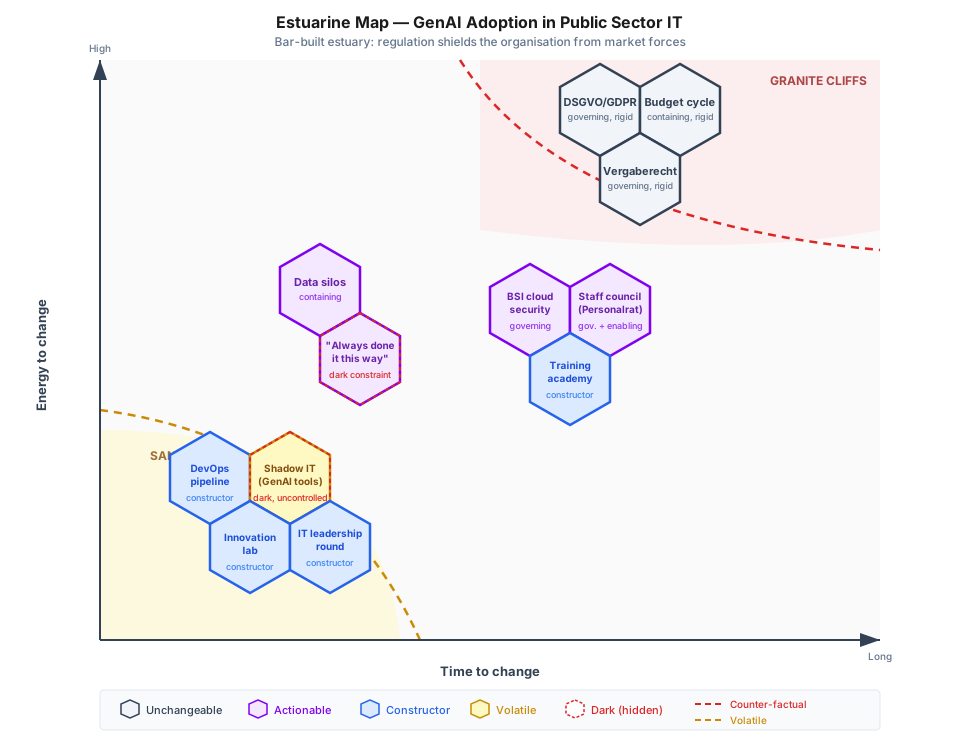
Above the counter-factual line: DSGVO, Vergaberecht, and the annual budget cycle. These cannot be changed by this group. They are granite cliffs. All GenAI initiatives must work within these boundaries. Katrin makes this explicit: “We stop talking about changing these. We design around them.”
Inside the volatile zone: The DevOps pipeline, the innovation lab, shadow IT usage, and the IT leadership round. These can change quickly with low effort, but their current state is unstable. Shadow IT in particular is a sandbank: it shifts daily and carries risk. One data breach and the staff council will shut everything down.
Designing Interventions
With the map in front of them, the group moves from analysis to action. Each intervention is small, reversible, and designed to shift specific actants.
| Actant | Action | Intervention |
|---|---|---|
| Shadow IT (GenAI tools) | Stabilize + Monitor | Don’t ban it. Catalog what teams are already using. Create a lightweight governance wrapper instead of prohibition |
| DevOps pipeline | Compass Rose | Extend the pipeline to include GenAI model deployment. Low energy, already familiar to teams |
| Innovation lab | Compass Rose | Redirect budget to run 3 GenAI proof-of-concepts with citizen service teams. Increase visibility |
| Training academy | Trigger | Launch a “GenAI for public servants” curriculum. Partner with an external provider for speed |
| “Always done it this way” | Interaction + Research | Pair resistant teams with early adopters. Collect and share success stories through internal channels |
| Data silos | Request | Propose a cross-department data catalog to the IT leadership round. Start with metadata, not migration |
| Staff council | Interaction | Involve early. Frame GenAI as augmentation (“better tools for existing roles”), not replacement. Co-design the training approach |
| BSI requirements | Research | Investigate BSI-compliant GenAI hosting options (on-premise LLMs, sovereign cloud). Present options to Katrin |
Direction of Travel
The interventions combine into three portfolios:
- Governance & Compliance: Shadow IT wrapper, BSI-compliant hosting research, staff council co-design
- Capability Building: Training curriculum, innovation lab PoCs, pipeline extension
- Culture & Adoption: Early adopter pairing, success story sharing, data catalog initiative
Each portfolio runs as a series of small, parallel experiments, not one large transformation program. The IT leadership round reviews progress monthly. The counter-factual line is reassessed quarterly: what was unchangeable six months ago may have shifted.
Katrin leaves the workshop with something she did not have before: not a strategy document, but a shared picture of the forces at play and a set of interventions sized to her actual room for maneuver.
Why This Works with AME3
In AME3 terms, the Estuarine Map feeds into the Tournament. Each portfolio becomes an Ambition or a set of Goals on the Enterprise Backlog. The individual interventions become Improvements that Teams pull during a Match. The monthly review follows the Anticipate, Advance and Assess loop. The constraint map ensures the organization does not waste energy fighting granite cliffs but instead focuses on what can actually move.
The Estuarine Map also enforces Overall Optimization: by making all actants visible across the enterprise, the portfolios can be evaluated against the Enterprise Product as a whole, not just the unit proposing the change.
Connection to AME3
| AME3 Concept | Estuarine Framework Equivalent |
|---|---|
| Empirical Control | The energy/time grid assessment and safe-to-fail experiments embody Empiricism: hypothesize, intervene, measure |
| Evolution Focus | Direction of travel reflects evolutionary positioning: where products and services sit on the Genesis-to-Commodity path |
| Overall Optimization | Making all actants visible across the enterprise prevents suboptimization. Each portfolio is evaluated against the Enterprise Product, not local outcomes |
| Tournament | The quarterly reassessment of the counter-factual and volatile lines mirrors the Tournament’s strategic AAA loop |
| Match | The cadence within which individual interventions are executed as Improvements by Teams |
| Improvement | Individual safe-to-fail experiments, the smallest unit of change |
| Ambition | Estuarine portfolios map to Ambitions: purpose, expected successes, and constraints for an Arena Product |
| Goal | Specific strategic objectives derived from the Estuarine direction of travel, guiding Teams within a Match cycle |
References
- Snowden, D. (2022). Estuarine Mapping (first edition). cynefin.io
- Snowden, D. (2023). Cynefin St David’s Day blog series. cynefin.io
- Snowden, D. (2024). Book chapters on complexity and uncertainty management
- NOAA. Estuaries: Classifying Estuaries by Geology. oceanservice.noaa.gov
- cynefin.io/wiki/Estuarine_framework
- cynefin.io/wiki/Constraints