The AI-Enhanced Team of the Future
Do we still need development teams now that AI agents can write, test, and deploy code? The answer is more surprising than you might expect. And not a simple yes or no.
The narrative is everywhere. Sam Altman predicts billion-dollar companies run by two or three people with AI. Mark Zuckerberg expects AI to replace mid-level engineers at Meta. Dario Amodei claims AI will handle “most, maybe all” of what software engineers do, while simultaneously hiring hundreds of them. The conclusion seems obvious: teams are disappearing.
Meanwhile, Vibe Coding and agentic AI let a single engineer coordinate dozens of specialized code agents to ship production features. Even those new to the field can achieve impressive results. My daughter, a design student with no previous coding experience, built a complete Mac desktop app in just two weeks, including the build setup, version control, and GitHub repository.
Critics might argue that code quality is lacking and that a junior developer may overlook important details. I heard similar concerns from C developers when I began using managed code runtimes like Java or .NET. However, the impact and scale of this shift with AI are even greater. There is no doubt about that.
The previous chapter mapped the strategic terrain and asked where to invest. This chapter answers the next question: who does the work, and how is the work changing?
Widening the Value Chain with AI
As AI and the Principles of Evolution argues, every major technology that promised to simplify work ended up doing the opposite. We used it to tackle greater complexity. AI follows the same pattern. It increases throughput and knowledge access, thereby expanding the scope of the value chain that a Team can manage. Teams persist, but what they take responsibility for grows.
Anyone who has worked with LLMs or diffusion models quickly sees that, while these systems are impressive at predicting human behavior, they have clear limitations. They do not replace human counterparts. We use them as tools to deliver products and services for people. When we want products and services to change, it is because humans desire it. AI helps simplify tasks to a remarkable extent, but it remains a tool directed by people.
An Enterprise seeks to manage all stages of the evolution flow, either by outsourcing to suppliers or by delegating to smaller social subsystems. The size and structure of these subsystems depend on their specific purpose, reflecting the cognitive and communication limits explored in Slicing the Organization and Slicing the Product. AME3 is designed to reflect this natural order for human systems:
- Medium Enterprise (50–5,000 people): covers the entire flow from genesis to commodity. An Enterprise provides commodity services to an Arena, delegating all non-commodity work to it.
- Arena (7–250 people): a highly independent business unit. It controls the value chain to deliver converging services and products to customers. It delegates genesis and emerging tasks to Teams and provides the necessary support for them.
- Team (5–9 people): primarily focused on genesis to custom/emerging tasks. Teams discover new ways to build and deliver to customers while establishing an initial stable process. They utilize co-creative approaches like pairing.
- Pair (2 people): focuses on genesis and concept work, especially when tasks are highly novel or urgent.
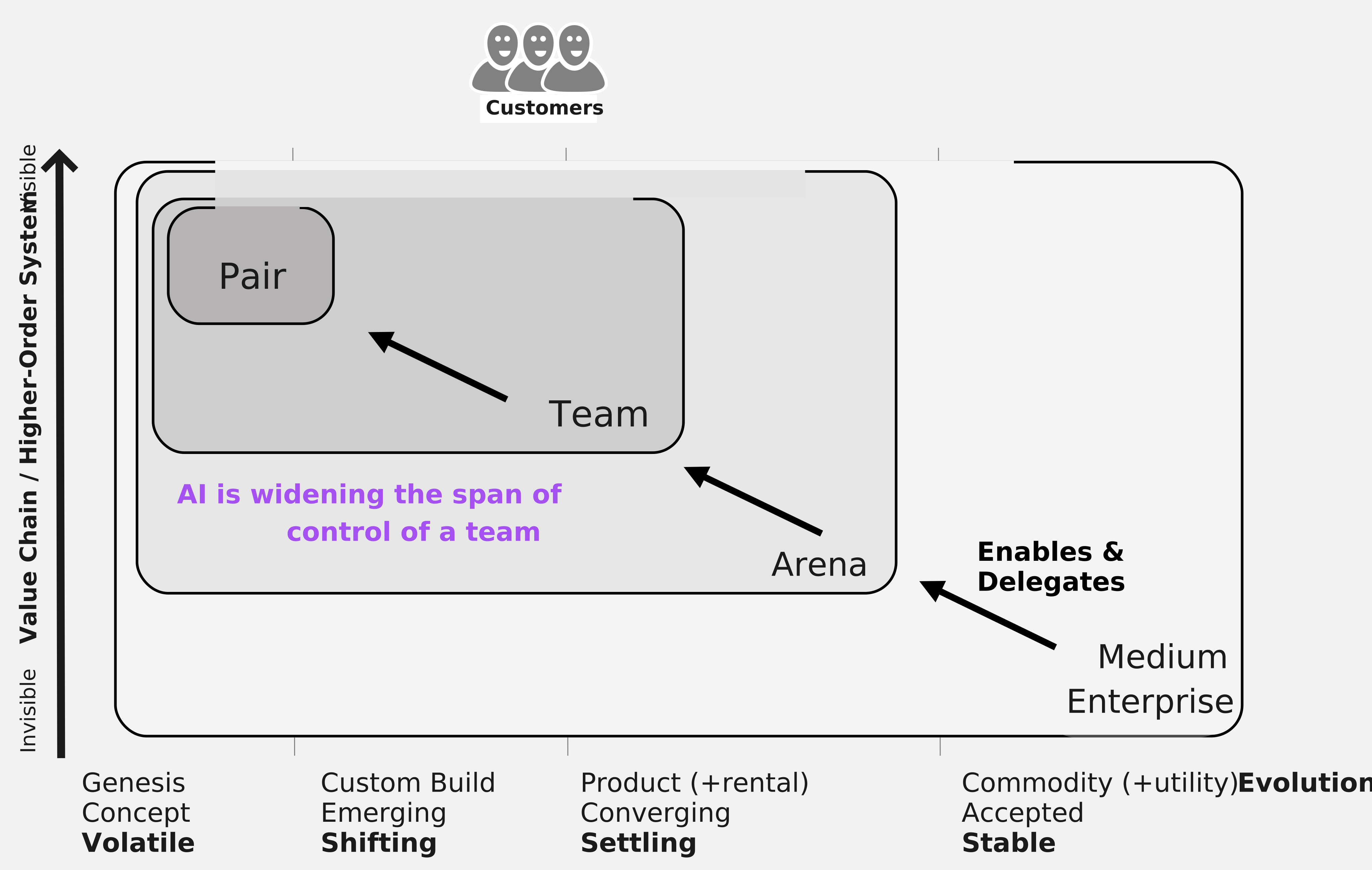
Teams are fundamental social systems. AI will not change this.
So ultimately, it is the Teams who drive progress and deliver value in an Enterprise. This is unlikely to change, as long as enterprises continue to seek progress and deliver value. However, the composition of teams will inevitably evolve.
How Teams Are Evolving
The pattern of team evolution over the decades is clear: fewer handoffs, faster feedback, and broader responsibility. AI will accelerate the next stage of this transformation. Let us walk through this evolution to understand it more clearly.
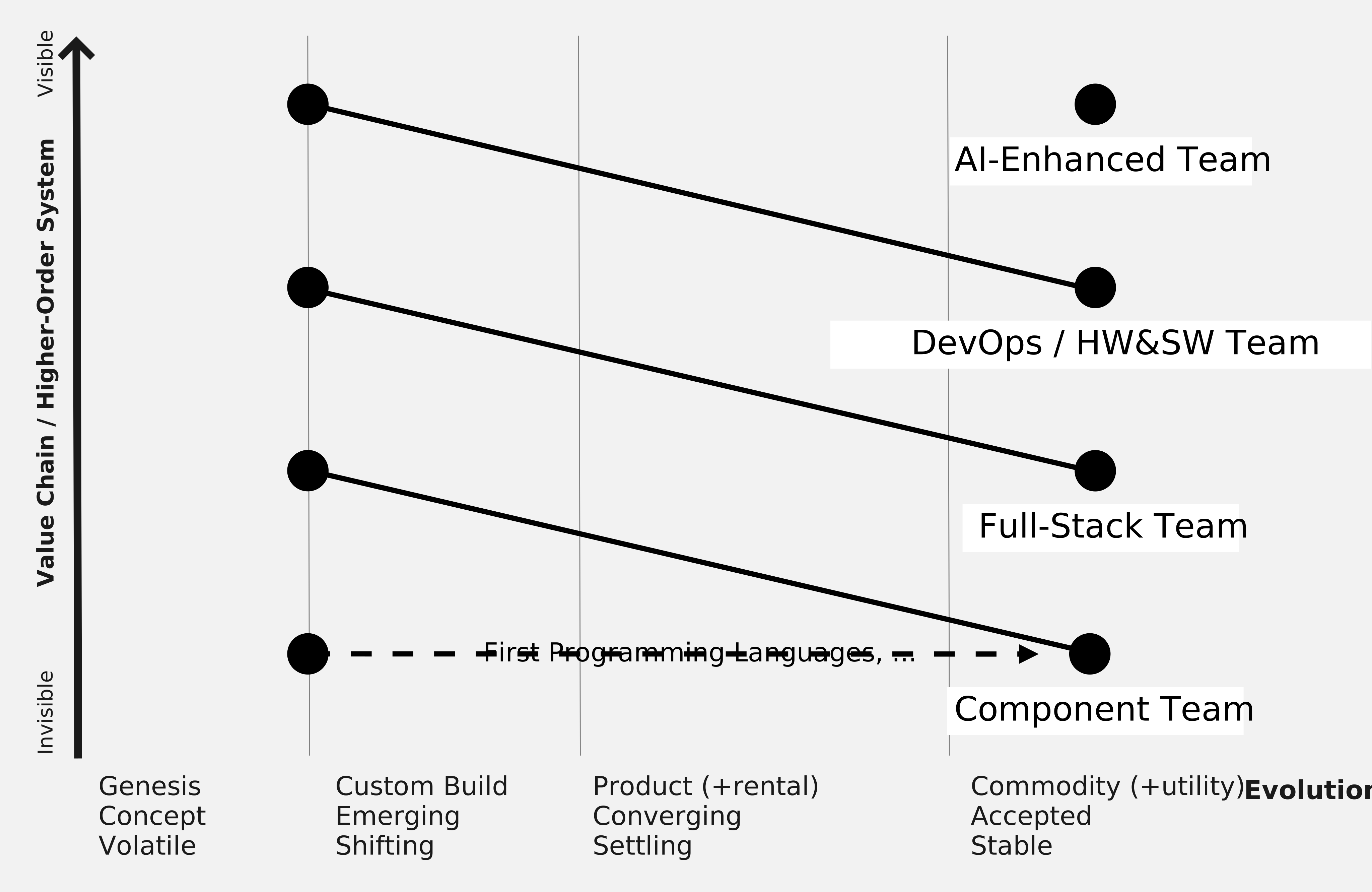
Era I: Component Teams
Enabled by the first programming languages.
- Work focus: isolated components and libraries; many handoffs to integrators.
- Constraints: limited tooling and automation; high coordination cost; long feedback cycles.
- Outcomes: quality inside components, but brittle integration.
Era II: Full-Stack Teams
Enabled by XP, integrated dev environments, and test automation.
- Work focus: vertical slices from UI to persistence; trunk-based flow; continuous testing.
- Constraints lifted: faster feedback; tighter product–engineering loop; fewer handoffs.
- Outcomes: shorter cycle time; improved responsibility and product fit.
Era III: DevOps / HW&SW Teams
Enabled by cloud computing and platformization.
- Work focus: build and run; infrastructure as code; observability; security by design.
- Constraints lifted: provisioning and deployment become utilities; scale and reliability increase.
- Outcomes: continuous delivery and on-call responsibility, including hardware where relevant.
Era IV: AI-Enhanced Teams
Enabled by vibe programming and agentic AI.
- Work focus: end-to-end business outcomes across customer demand, design, system architecture, service improvements, operations, and market growth.
- Constraints lifted: generation, integration, and orchestration shift to AI agents; humans focus on intent, constraints, and verification.
- Outcomes: teams are responsible for complete business capabilities and micro-enterprises, with AI as force multipliers.
This pattern has a precedent. In chess, human-computer teams have outperformed both pure grandmasters and pure chess engines. Garry Kasparov called them centaurs. The AI-Enhanced Team is the enterprise equivalent of the centaur: not human or machine, but human with machine.
Some argue that AI will dissolve traditional teams into fluid, dynamic configurations: pods, wings, pairs with AI assistants, dynamic reteaming within larger groups. These structures are not new. In well-functioning scaled organizations like LeSS, you already see groups of 50 to 60 people who know each other well enough to reconfigure their Team structure from Match to Match as needed. AI does not invent dynamic teaming. It makes it practical at a scale and speed that was previously impossible.
We call them AI-Enhanced Teams. What they become next depends on the domain.
In pure software and IT areas, these teams will become Full Business Teams, as they can easily achieve many end-to-end business outcomes within a single cadence. In other domains, even with AI, this level of integration may not be possible. For example, mass production and product development might still require separate teams. However, fewer specialized areas will be necessary, handoffs will be reduced, and cycle times will be shortened.
Full Business Teams existed even before the rise of AI. For example, the team I led as Product Owner for seven years operated in this manner. We were a single-Team company, running very lean and outsourcing most commodity functions. Working in this way required special and radical conditions, making Full Business Teams quite rare, especially in larger organizations. Our hypothesis is that this model will soon become the new normal.
The team evolution model above focuses on how teams deliver. But GenAI also enables entirely new products and services, or drives major enhancements to existing offerings. We examine this dimension in Developing a Strategy for the GenAI Era.
What Changes for Humans?
This is likely the biggest question on your mind, and on the minds of your employees and colleagues. I am asking it myself. Tudor Girba and Simon Wardley frame it sharply in Rewilding Software Engineering: “The most important architectural question of today is: at what point do I value human decision making?”
GenAI has the potential to create an impact as significant as the internet. We can expect many changes to our current beliefs and ways of working. What we know so far:
Intent and constraints. The human skill shifts from specification to evaluation. Instead of writing detailed requirements or user stories with acceptance criteria, Teams define outcome boundaries and let agents propose implementations. The question changes from “How do we build this?” to “What should the machine not do?” This is the Governor role described in Interplay/AI/The End of Software as We Know It.
Taste and ethics. When AI generates the output, someone must judge whether it is good enough. Code review becomes output review. The reviewer needs domain judgment, not syntax knowledge. As Girba and Wardley observe, Vibe Coding “works for prototypes, but the troubles occur when you start to care about the result.” Quality standards, ethical boundaries, and brand voice become the human contribution that no agent can replace.
Evaluation and acceptance. The Definition of Done becomes the governance framework for AI-generated work. Teams define tests, guardrails, and meaningful measures. The AAA-Loop provides the inspection rhythm: every cycle, the Team assesses what the agents produced and whether it meets the standard.
Collaboration shifts. Pair Programming evolves into human-AI pairing. Team coordination shifts from task assignment to agent orchestration. System Leads need new facilitation skills: helping Teams design effective agent workflows, setting boundaries for autonomous operation, and ensuring that human judgment stays in the loop where it matters.
Domain knowledge becomes more valuable, not less. When the Meridian Industries documentation division was disrupted by AI, the employees who moved into Arenas and experiment teams brought irreplaceable product knowledge. They understood how customers learn, where they struggle, and what the product actually does in the field. No agent had that context. The Jevons Paradox offers a parallel: when AI lowers the cost of execution, teams do not shrink. They take on more. Demand for human judgment grows with the scope.
The craft moves up the stack. People will spend less time on integration and more time shaping impactful outcomes. The programmer, the engineer, the designer becomes the orchestrator: someone who can direct AI agents toward the right problems, evaluate results with domain expertise, and make the judgment calls that determine whether the product serves the customer.
The Transition Playbook with AME3
A practical flow to move from today’s model of work to AI-enhanced teams:
- Map the landscape using Wardley Mapping to identify the next goal you want to achieve, leveraging the potential of GenAI. Start by asking one of the questions in Developing a Strategy for the GenAI Era.
- Begin with a single Team or even a pair of specialists. Run experiments to validate your hypothesis.
- If the initial experiments are successful, proceed with the same team but be prepared to change its composition. Strengthen your data and guardrails. Enhance data quality, observability, and develop security policies to ensure AI agents can operate safely.
- Pilot a single product or service capability with a strong emphasis on delivering customer value. Choose a focused scope, such as a specific feature or internal service, leveraging an agentic toolchain.
- Measure value delivered and customer signals.
- Scale beyond the team. Leverage your team’s expertise in GenAI technologies, customer experience, and modern collaboration methods. Expand to multiple teams within an Arena, or even launch a new Arena that operates highly independently from the rest of the organization to scale faster and adapt more swiftly to changing markets and AI advancements.
All of this must take place within a lean and adaptable governance structure at the enterprise level. Ensure that new teams are integrated into the strategic empirical control loop of AME3.
Conclusion
So, what is the answer to the question, “Do we still need development teams now that AI agents can write, test, and deploy code?”
If you define development as coding, then yes, we will see these types of teams disappear. If you define development as creating next-generation products and services, then this has always been, and will continue to be, the domain of teams.
Sam Altman’s billion-dollar company with two people is not a team disappearing. It is a team of two whose agents handle what previously required fifty. The team is smaller in headcount but broader in capability. Zuckerberg’s mid-level engineers are not being replaced by machines. They are being replaced by engineers who work with machines. And Amodei’s paradox resolves itself: you hire hundreds of people because AI expands what is possible, and you need humans to direct that expansion.
AI does not remove the need for teams. It changes what teams take responsibility for and how they deliver. Focusing only on software-based products and services, where the most visible changes are occurring, would be a major mistake. AI now offers the opportunity to break down long-standing barriers between R&D, IT, engineering, and business functions. Failing to embrace this shift will put your organization at a significant competitive disadvantage.
In AME3 terms, Teams widen their scope across the value chain and become responsible for more end-to-end business capabilities. Humans set direction and standards. Agents accelerate delivery and integration.
The future team is not smaller. It is broader, more empirical, and closer to the customer. It wins by learning faster than the market changes.
But teams build products, and the most visible product in the AI shift is software itself. Software has the most data, the most experience, and the fastest evolution path of any domain. AI changes not only how software gets built, but how we use it. Interplay/AI/The End of Software as We Know It traces that inversion, from operating tools to governing the machines that operate them on our behalf.