The System Lead
Enhancing effectiveness of the work system
Ownership responsibility sets the direction. The catalyst for continuous improvement is the System Lead. Through the lens of Velox Robotics and Meridian Industries, we will explore how System Leads within AME3 enhance effectiveness and adaptability.
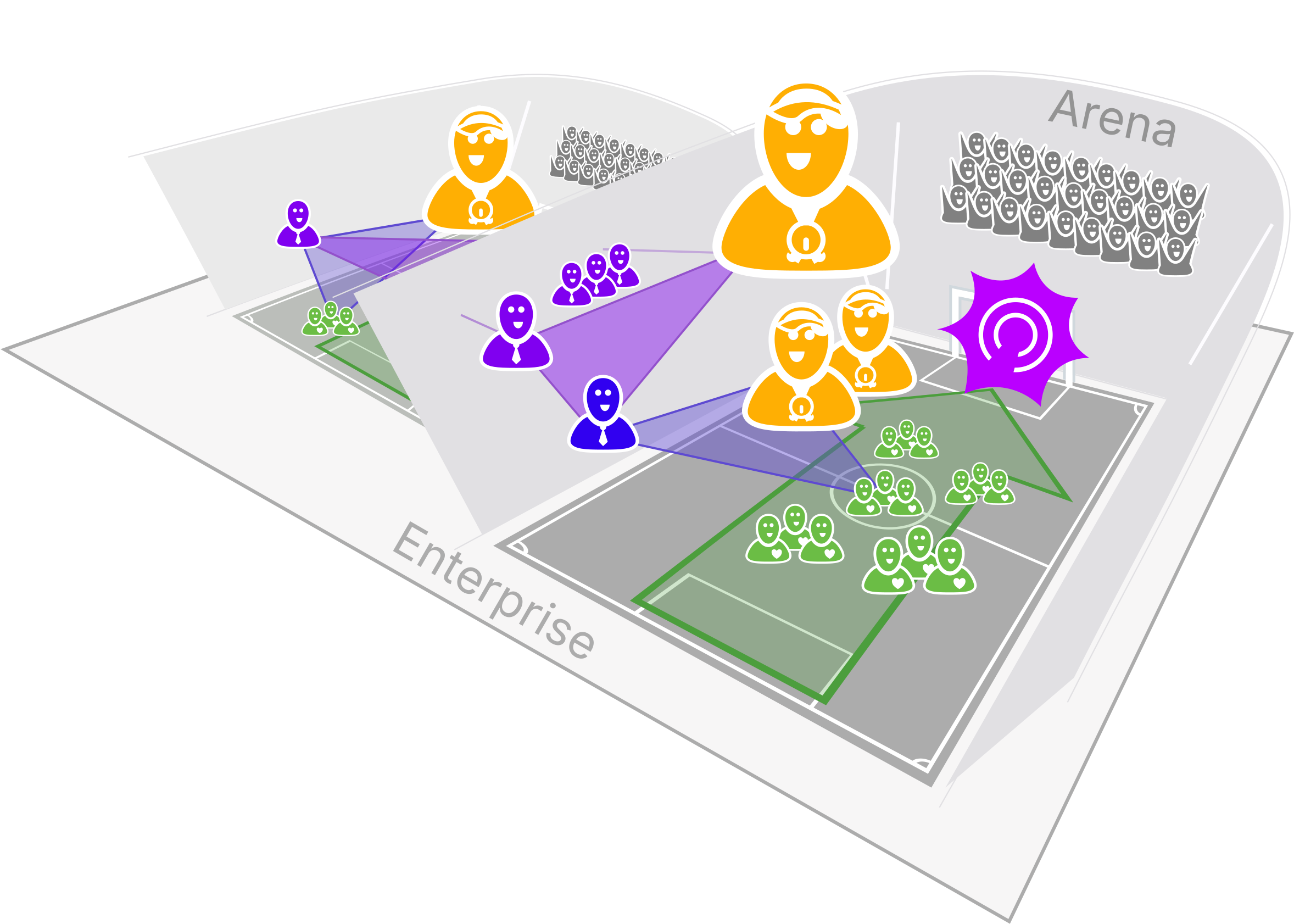
Example: Velox Robotics
Culture follows structure – Larman’s Laws
Velox Robotics adopted AME3 early, thanks to one of its first employees. She took on the function of System Lead and maneuvered the founder into the function of Arena Owner.
While AME3, unlike Scrum, is not exclusively designed for the complex domain, it recommends Scrum for the given situation. Scrum defines specific roles for a team working in complex environments. It is perfect as the leading framework for a start-up in its early stages. The functions of Owner, System Lead, and Team in AME3 align on the principle level with the Scrum roles of Product Owner, Scrum Master, and Developer.
As the organization grew beyond a single Scrum Team, establishing essential functions such as finance and HR alongside the development teams became straightforward. Within AME3 she could easily integrate other frameworks and methods. In her case, Large Scale Scrum for the development and Kanban to organize the basic corporate functions.
The company has since grown to 50 employees. Growth also means the development of the teams and people skills. It is the System Lead’s job to constantly develop these further. Teams had to be newly formed and built up with new employees. New practices had to be learned, and old ways of doing things had to be unlearned.
The System Lead also had to act if an employee could not be integrated into the Teams permanently, sometimes leading to parting ways with them. She handled these actions personally. For other matters, she facilitated the process. Consequently, decisions on new hires were made collectively by team-representatives, the Arena Owner, and the System Lead.
As the number of Teams increased, so did the number of System Leads. At the time in question, four more System Leads were grouped around the first System Lead. There are various focal points to which the System Leads are dedicated. For example, facilitating the recruiting process, introducing and adapting engineering methods, continuous coaching on product strategy.
As Conway’s law predicts, the product architecture mirrors the organizational structure. One of the most enduring challenges is the strong dependency and the necessary communication between the Teams. What was still somehow feasible with 30 employees is now starting to become a real problem. More and more isolated solutions are being developed by the Teams which are not integrated into the common Arena Product, and therefore are not usable by the customers. So, although the organization has grown in employee numbers, the overall performance has not improved.
Teams often opt for isolated solutions to avoid waiting on other Teams for results or decisions, a problem that intensifies with each new hire. The only solution for future growth is to design the Arena Product architecture so that Teams have minimal overlapping activities. Furthermore, it is crucial to enhance the Teams’ self-organization and engineering skills.
The System Leads must therefore work very closely with the Owner and the Teams to repeatedly conduct experiments with them to promote new insights for the Arena Product architecture, organizational structure and practices.
One of the most effective experiments was introducing AI coding assistants into the Teams’ daily work. Developers could now explore unfamiliar parts of the codebase without waiting for colleagues from other Teams. Code reviews that used to require cross-team coordination happened faster. But the real leap forward was unexpected.
With AI coding assistants, hardware engineers started contributing to software. The barrier that had kept hardware and software expertise in separate Teams dropped. For the first time, the System Leads could form truly cross-functional Teams where hardware and software engineers worked side by side on the same design challenges. These Teams made better design decisions because the question of what to solve in software and what to solve in hardware was no longer negotiated across team boundaries. It was resolved within the Team.
The System Leads together as a unit have taken on the responsibility of optimizing the entire work system, which Andy and I call Arena in AME3.
Example: Meridian Industries
In The Owner, we observed how the Enterprise Owner developed and prioritized the Enterprise Backlog, focusing the organization on a few key Goals. Initial Arenas and Products utilizing the AME3 structure were also identified. This strategic plan was created with input from Accountable Representatives and experts, guided by an experienced external consultant.
At the end of this process, the Enterprise Owner offered the external consultant a continuous function as System Lead to facilitate the process of inspecting and adapting the enterprise strategy on a permanent position, making him the Enterprise System Lead. His initial task was to align the existing board and executive meetings.
The refined structure now integrates a strategy workshop with all Accountable Representatives every three months, coupled with a weekly alignment meeting that includes the Enterprise Owner, Arena Owners, and the executive management. In AME3, this enterprise-wide cycle of inspection and adaptation is called a Tournament.
During this initial process, two potential Arenas and their corresponding Products were identified:
- The division dedicated to the development and production of a globally successful laser welding tool family.
- A novel machine tool that potentially leverages a new approach to 3D printing, synergized with cutting-edge AI-based control software.
From the enterprise’s perspective, the two highlighted Products bore striking resemblances, as they both held immense strategic value.
In addition to these considerations, the following factors significantly influenced the selection of the first Arena Product:
- The development and production of the laser welding devices were able to operate relatively independently of other organizational units without significant reorganization.
- The dependencies on suppliers were already managed by the unit, so changes could be managed directly.
- The development already used Scrum, and the production had experimented with Lean Management practices. However, a comprehensive approach was yet to be established, which is precisely what an Arena in AME3 is offering.
In collaboration with the Scrum Masters and people leads, the Enterprise System Lead formulated an improvement plan for the Arena. This plan encompassed the establishment of Matches for the entire Arena, the creation of an Arena Backlog, and aligning the Arena with the enterprise’s Tournament. The Arena Owner of the Arena, previously the head of production and now also accountable for development, added these measures to the Arena and set the final priorities. At a later point, Scrum Masters and people leads reorganized. Some transitioned into System Lead function, while others filled the gaps as highly needed experts within the Teams.
The second Arena Product, the 3D printer machine tool, followed a path similar to the start-up. The Arena Owner was a former product manager with a strong engineering background. The System Lead’s role was taken on by an experienced Scrum Master, a fresh hire by the Enterprise System Lead and the Arena Owner. Unlike the laser welding Arena, this one started from scratch: new Teams formed from employees across the enterprise and external hires, with no legacy structures to navigate.
Within the rhythm of the Tournament, the Enterprise System Lead and System Leads of the two Arenas continuously inspect and adapt their organizational development work. This process is always aligned with the Arena Product goals set by the Arena Owners and Enterprise Owner. It also includes Team and people development activities, such as exchanging experiences between the two Arenas.
Rules
The formal Rules for the System Lead and Enterprise System Lead grant real authority: the right to establish, discard, and demand compliance with rules beyond AME3. If a Team needs Scrum, the System Lead implements it. If a practice stops serving the Arena, the System Lead removes it. The Rules also ensure that System Leads remain collectively accountable for all Teams, preventing the fragmentation that occurs when each coach only cares about their own players.
Conclusion
In both companies, the System Leads serve the Enterprise by developing the competencies of Teams and people, facilitating decision-making, and sustaining a continuous cycle of Anticipate, Advance, and Assess.
A good coach is invisible in the result but essential to the process. The Teams deliver, the Owner sets the direction, but it is the System Lead who ensures the organization is capable of getting there. The best work systems are the ones nobody notices, because they just work.
The Team explores the often underestimated third leadership function. The Playbook chapters on organizational design and product slicing show how these decisions play out in practice.