The Team
Leading to customer satisfaction
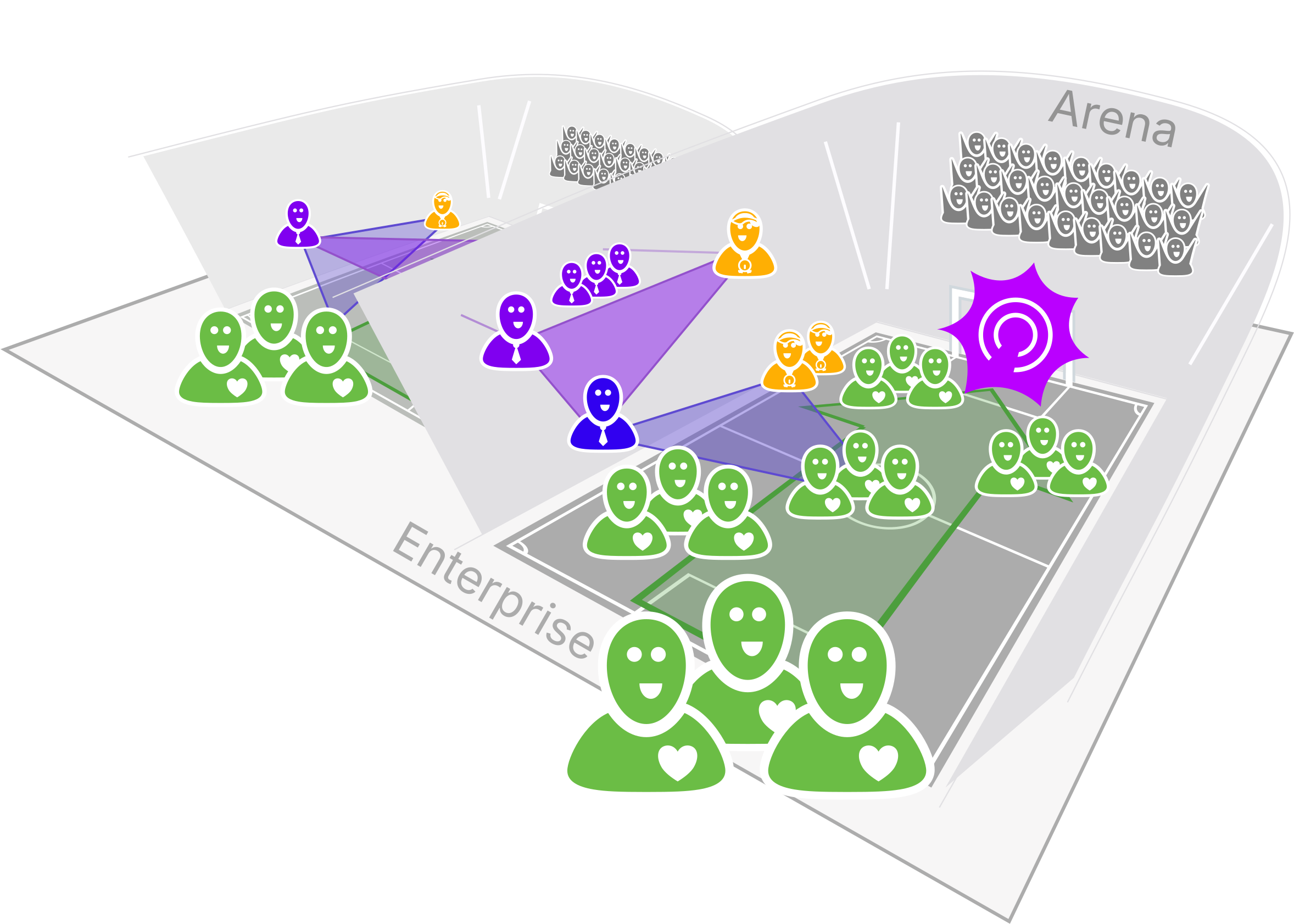
The Owner and The System Lead set direction and build the work system. This part concentrates on the often underestimated leadership function of the Team, further enriching the stories of Velox Robotics and Meridian Industries.
Example: Velox Robotics
What motivates people: Autonomy, Mastery, and Purpose – Drive, by Dan Pink
In the early years of Velox Robotics, hardly anyone thought about leadership or management. Everything seemed to happen naturally and felt quite organic.
New ideas were pursued with vigor when they ignited a spark of excitement within the Team. Given that the purpose of any activity serves as a significant catalyst for motivation, every Team member was naturally driven to cater to customer needs, all in the pursuit of positive feedback.
Surely, in many cases, it was more about experimenting. Whether there was indeed a customer need was just a hypothesis. Likewise, new technical solutions were passionately developed, tested, and often discarded. Experts were consulted. If the proposed solutions were suitable, these experts often joined the Team, as enthusiasm is known to be contagious.
The chapters on ownership and system leadership showed that this naturalness was in danger of being lost after the period of early growth. AME3 in conjunction with the application of frameworks like Scrum and later the LeSS framework helped the employees preserve the naturalness of the early years.
The organization discovered that work flows more efficiently when Teams are empowered to make timely decisions independently. This autonomy extended to their commitment to creating value for customers.
Thus, it remains entirely self-evident that all the work is self-managed by the team members. Especially when this means close coordination with other Teams, customers, and suppliers.
Therefore, the System Lead ensured that every employee received leadership and communication training. This significantly contributed to the Teams’ performance improvement.
As the company expanded, the primary focus of creating solutions that enhance customer satisfaction remained with the Teams. Yet, customer satisfaction is not the sole interest of a business. Velox Robotics also had to make tough decisions that were not always in favor of all potential customers to maintain profitability and focus. These decisions were made by the Arena Owner. However, the data and intelligence needed for these decisions, and even the identification of which decisions needed to be made, came from the experts within the Teams. Not the Arena Owner leads the Team through decisions, but the Team leads the Arena Owner to the decisions.
The Arena Owner and Teams engaged in a continuous feedback loop of Matches (Sprints) and Tournaments. This process, facilitated by System Leads, helped them develop a nuanced understanding of how to delegate. They learned who needs to make decisions, how these decisions should be made, and when to involve or inform others.
Example: Meridian Industries
The Team’s situation within Meridian Industries varies significantly from one Arena to another, and even within the Arenas themselves.
When the 3D printer Arena was created, new Teams were formed with employees from other parts of the enterprise and by hiring new experts. Old rules and structures ceased to exist overnight. With a fresh start in mind, employees readily embraced and championed this new approach to work. This process also developed a strong sense of customer satisfaction by the Teams.
The Arena of the laser welding tool family, already familiar with Lean and Agile methods, found the transition to AME3 initially subtle. However, the new overarching structure began to address deeply rooted problems tied to team dependencies. They now had a platform to address these issues during the Anticipate, Advance and Assess phases of Matches and Tournaments. Yet, team reorganization, and the learning and unlearning of practices, remain an integral part of this routine.
Since the first two Arenas launched, three more were created in line with the Enterprise’s strategy for evolution. The employees who joined these new Arenas brought the habits of their previous work with them. They had spent years in specialized groups, working as business analysts or data engineers, separated from the customer. That separation had dulled their sense of ownership over the Arena Product and their connection to customer satisfaction.
However, the new Arenas can now leverage the experiences of the initial ones. Teams and System Leads from existing Arenas are transitioning to the newly created ones, serving as on-the-job mentors. System Leads facilitate lightweight exchange formats between the Arenas to maintain the flow of knowledge.
Rules
The formal Rules for the Team establish that each employee belongs to only one Team at a time, with stable membership over at least one Match. Teams do all the work to develop, provide, and maintain the Arena Product. These constraints eliminate the context switching and divided loyalty that cripple most organizations.
Conclusion
The Owner sets the direction. The System Lead builds the work system. But neither creates value for the customer. That is the Team’s job. Teams manage and execute the work, create value and ensure quality, and identify the improvements that truly matter. Every structure in AME3 exists to serve this function.
The best indicator of a healthy leadership system is not how well the leaders lead. It is how well the Teams deliver.
With all three leadership functions in place, the Rules chapter defines the formal constraints that hold the system together. The Playbook shows how to put it all into practice.