Stacey Matrix
Stacey, R.D. (1996). Strategic Management and Organisational Dynamics. 2nd ed. Prentice Hall | Habermann, F. (2020). Agile Populism — The Stacey Matrix
The Stacey Matrix (also known as the Agreement & Certainty Matrix) was introduced in 1996 by Ralph D. Stacey in the 2nd edition of his textbook. The original diagram uses two axes — Agreement and Certainty — and distinguishes five decision-making zones: (1) technically rational, (2) political, (3) judgmental, (4) zone of complexity, and (5) chaos/anarchy.
Stacey himself later regretted the diagram and removed it from the 4th edition (2003): “I no longer use the diagram because it is simply interpreted in a way that sustains the dominant discourse while using the alternative jargon of complexity.”
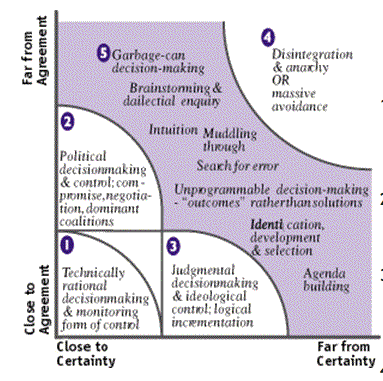 Ralph D. Stacey’s original matrix
The widely used version with the zones “Simple, Complicated, Complex, Chaotic” does not originate from Stacey but from Brenda Zimmerman (~2001), further modified by Ken Schwaber (2004), who renamed the axes to “Requirements” and “Technology” without justification.
Peter Beck has renamed the axes to What and How and uses the model extensively in Scrum training exercises. Contrary to Stacey’s own critique, he finds the model highly valuable in discussions with participants. It exposes the organizational silos commonly found in enterprises: Business/Customer (What) vs. IT/Tech/R&D (How). The model challenges the widespread belief that “the other side” is simply not performing well enough. It helps participants understand that complexity is real for everyone — including the other side.
 Complex Space and Scrum Matrix by Peter Beck
Consider the What axis: when an engineer asks a customer what problem they want solved, the answer may be vague, wrong, or absent — not because the customer is incompetent, but because the problem space is genuinely uncertain. As Henry Ford reportedly put it: "If I had asked people what they wanted, they would have said faster horses." Sometimes we cannot even ask the right question, because we are dealing with unknown unknowns.
The How axis works the same way: when a business stakeholder asks an engineering team to estimate a technically novel project, the honest answer is often “we don’t know yet.” An engineer cannot give an accurate timeline for a problem they have never solved before — not because they lack skill, but because the solution space is genuinely complex. Demanding a precise estimate under these conditions does not reduce uncertainty; it merely creates an illusion of certainty.