Start the Game for the Enterprise
The Bird’s Eye View
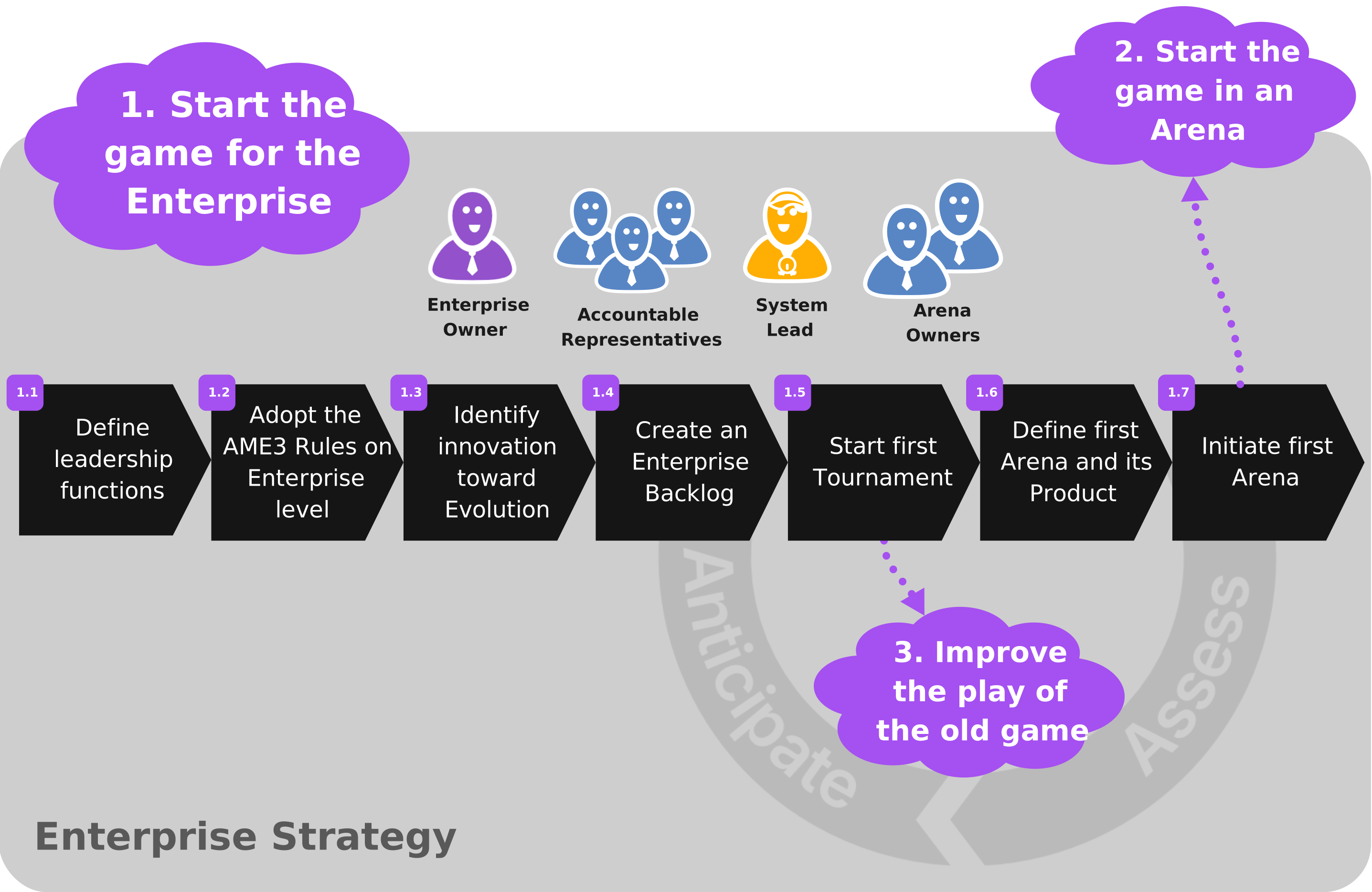
The following diagram shows the complete AME3 Playbook at a glance. It maps the path from enterprise-level governance through Arena creation to continuous improvement. Use it as a reference as you work through the steps in the next three chapters.
Why Start at the Enterprise Level?
Many organizations adopt agile methods and lean practices at the team level. Teams run Sprints, hold Retrospectives, and improve locally. Yet the enterprise as a whole does not evolve. Decisions still flow top-down. Strategic priorities remain unclear. Teams optimize their own work while the organization drifts.
This is sub-optimization. Without enterprise-level alignment, tactical improvements stay local. They do not compound into strategic advantage. Teams pull in different directions. Investments scatter across too many initiatives. The result: effort without impact.
In the Leadership chapters, we followed Meridian Industries, a medium-sized enterprise with 1,200 employees. The original founders had moved to the supervisory board. A new CEO was appointed to enhance profitability and drive innovation. She inherited an organization stuck in functional specialization, with over 120 active projects showing little progress and value-creation experts burned out from juggling 4-5 projects each. This chapter follows how she started the game at the enterprise level.
AME3 addresses sub-optimization by starting at the enterprise level. Before any Arena begins its work, the enterprise establishes lightweight governance: clear leadership functions, shared Rules, and a Strategy that guides evolution. This is not a heavy bureaucracy. It is the minimum structure needed to ensure that every Arena’s work contributes to the enterprise’s strategic direction.
The approach is empirical. Rather than planning a complete transformation upfront, AME3 creates a feedback loop at the enterprise level, the Tournament, where leaders inspect progress and adapt strategy based on evidence.
The Steps
The following seven steps establish enterprise-level governance. They are sequential, and each builds on what the previous step created.
1.1 Define Leadership Functions on the Enterprise Level
Establish the enterprise-level leadership functions. The Enterprise Owner takes accountability for the success of the Enterprise Product. Accountable Representatives provide oversight and ensure alignment with the enterprise’s broader obligations. The Enterprise System Lead ensures effective structures and processes across all Arenas.
These are not new management layers. They are clearly defined accountability functions that replace ambiguous decision-making with transparent leadership.
1.2 Adopt the AME3 Rules on the Enterprise Level
Adopt the Rules as the shared operating agreement for the enterprise. The Rules establish a common language and foundational practices. They define how Arenas relate to the enterprise, how strategic decisions are made, and what autonomy Arenas have.
The Rules are deliberately minimal. They provide just enough structure to enable coherent evolution without constraining how individual Arenas organize their work.
1.3 Identify Potential for Innovation
Analyze the current state of all products, services, and organizational structures. Where is the enterprise today on the evolutionary path? What is evolving well? What is stagnating? Where do market opportunities or competitive pressures demand attention?
Use Wardley Mapping to assess the strategic terrain. Map your products and services along their evolution from Genesis to Commodity. This reveals where new Arenas could create the most value and where existing work needs strategic realignment. Estuarine Mapping complements this by revealing the internal and external forces that enable or resist change. Developing a Strategy for the GenAI Era provides worked examples of both methods.
These are not the only options. Other strategic tools can serve the same purpose: portfolio analysis, customer journey mapping, competitive benchmarking. The choice depends on your context. What matters is that you experiment: try a method, assess the results in the next Tournament, and adapt. The strategic method itself is subject to Empirical Control.
The CEO and the external consultant ran Wardley Mapping sessions with the supervisory board, experienced managers, and team experts. Two products emerged as strategically critical: the globally successful laser welding tool family and a novel 3D printing machine tool with AI-based control software. The mapping also revealed something unexpected: the 3D printing opportunity was evolving faster than anyone had assumed. What the board had treated as a research project was already approaching Custom Built. The window for competitive advantage was narrowing.
But the map showed a second surprise. The technical documentation and customer training division, long considered a stable, profitable service business, was under threat. AI-powered tools were beginning to let customers generate their own documentation and training materials directly from product data. The supervisory board initially dismissed this as a niche trend. The CTO disagreed. He had seen customers cancel training contracts and replace them with AI-generated onboarding in a matter of weeks. The CEO put it on the Enterprise Backlog as a strategic Goal: assess the impact and formulate a response within two Tournaments.
This assessment creates the raw material for strategic prioritization. It reveals not just what exists, but where the enterprise should invest next. In times of rapid AI evolution, it often reveals threats that nobody was watching.
1.4 Create an Enterprise Backlog
Build the Enterprise Backlog, the ordered list of strategic Goals for the entire enterprise. The Enterprise Owner orders this backlog based on strategic priorities. Accountable Representatives, experienced managers, and team experts collectively define and refine Goals. As Arenas are created, their Arena Owners join this process.
The Enterprise Backlog makes strategy visible and actionable. Every Goal represents a concrete strategic objective, not a vague aspiration. This transparency enables informed trade-offs and prevents the silent accumulation of conflicting priorities.
The CEO replaced the portfolio of 120 active projects with a single Enterprise Backlog. The external consultant introduced Kanban to manage the flow of Goals from identification to completion. The hardest part was not the method. It was telling more than 80 project sponsors that their initiative was no longer a priority. Every project had a constituency. Every canceled initiative had a manager who had staked their reputation on it. But the alternative was worse: continuing to spread resources so thin that nothing moved forward. The Enterprise Backlog forced a choice that the old portfolio system had avoided for years.
1.5 Start the First Tournament
Launch the first Tournament, the enterprise-level cycle of strategic inspection and adaptation. During a Tournament, Accountable Representatives assess the Enterprise Product while the Enterprise Owner decides on strategic changes to Ambitions and the Enterprise Backlog.
The Enterprise System Lead is responsible for facilitating this process. Start by reviewing the existing communication structures on the enterprise level: board meetings, executive reviews, strategy offsites. Most enterprises already have regular meetings that serve parts of this purpose. The Tournament does not replace them. It aligns them into a coherent cycle of inspection and adaptation.
Do not create new meeting structures from scratch. Use what exists and reshape it. The purpose changes, the calendar does not. As Arenas are created, their Arena Owners join the alignment.
The Enterprise System Lead designed the Tournament structure from what already existed. The supervisory board had been meeting monthly for a short two-hour update. The C-Level had a weekly cadence. He reshaped the purpose and the agenda, not the calendar.
The Accountable Representatives included three groups: the founding family on the supervisory board, three independent board members, and the management board (CEO, CFO, CTO). Together they formed the strategic governance layer.
A new two-day workshop every quarter opened and closed the Tournament loop. This was the deep strategic session where Accountable Representatives reviewed the Enterprise Product, challenged assumptions, and set direction for the next cycle. Between these workshops, monthly half-day meetings kept the rhythm. The agenda followed a simple structure:
- Review of Enterprise Goals and progress since last meeting
- Product demonstrations by Arena Teams: working results, not slides
- Strategic update: what has moved on the landscape, what new signals emerged
- Enterprise Backlog refinement: new Goals, re-ordering, completed Goals
- Decisions: new Arenas, resource allocation, strategic pivots
- Open discussion: impediments, cross-Arena dependencies, cultural observations
The product demonstrations were the heartbeat. Teams showed working results to the people who set the strategy. Even more important, Teams presented new potential they had discovered through their work: opportunities for products and services that nobody had anticipated. This closed the feedback loop between tactical execution and strategic direction. When the supervisory board members saw an Arena Team demonstrate a working prototype, they understood in ten minutes what a quarterly report had failed to communicate in ten pages.
Weekly alignment meetings with the Enterprise Owner, Arena Owners, and C-Level kept operational decisions flowing between the sessions. Shorter, focused: impediments, cross-Arena dependencies, resource decisions. The Enterprise System Lead had a goal he did not announce: forming this group into an enterprise team. People who commit to creating value together, not against each other. The same expectation they set for Teams in the Arenas. Over time, the weekly alignment became exactly that.
1.6 Define the First Arena and Its Product
Select the first Arena by formulating an Ambition. The Ambition defines the purpose, expected successes, and constraints for an Arena Product. It justifies why this Arena should exist and provides the strategic frame for its Arena Owner.
Choose carefully. The first Arena sets the pattern for all that follow. Pick a product or service area where AME3 can demonstrate clear value. Consider: can this unit operate relatively independently? Are there existing practices (Scrum, Lean, Kanban) to build on? Are supplier dependencies already managed within the unit?
1.7 Initiate the First Arena
With the enterprise-level structures in place and the first Ambition defined, initiate the first Arena. Appoint an Arena Owner and transition into the arena-level setup described in Start the Game in an Arena.
The Arena Owner should be the person closest to the product and the Teams, not necessarily the most senior executive available. The Arena Owner needs to be where the work happens. C-Level executives often serve the enterprise better as Accountable Representatives, contributing strategic oversight from the Tournament, than as Arena Owners caught between boardroom obligations and product decisions.
The laser welding division was selected as the first Arena. It could operate relatively independently. Its supplier dependencies were already managed internally. Development already used Scrum, and production had experimented with Lean. The head of production became the Arena Owner. The CTO had initially expected the role for himself. But the Enterprise System Lead argued that the Arena Owner must be where the work happens, not in the boardroom. The CEO agreed. The CTO became an Accountable Representative instead, contributing strategic oversight from the Tournament.
The rest of the organization watched. For the Teams inside the new Arena, it was a beginning. For the nearly thousand employees outside, it raised a question: what happens to us? We will continue their story in Improve the Play of the Old Game.
The rest of the organization continues operating as before. Employees move to Arenas as they are needed. There is no big-bang reorganization. The enterprise evolves one Arena at a time, guided by strategic Goals and governed by the Tournament cycle.
When the Terrain Shifts
The steps above establish the governance structure. But the real test of that structure is not the setup. It is what happens when the terrain changes. AI is accelerating evolution across industries. Products that seemed stable can shift toward Commodity in months, not years. New opportunities emerge that did not exist when the Enterprise Backlog was first created. The Tournament exists precisely for these moments.
Eighteen months after the first Arenas launched, the Wardley Map prediction from step 1.3 arrived faster than anyone expected. The technical documentation and customer training division, 80 employees, lost 40% of its revenue. Customers adopted AI-powered documentation tools. Training enrollment declined as companies built internal AI-assisted onboarding. A business branch that had been profitable for a decade was dying.
The CEO did not wait for the next quarterly Tournament workshop. She reprioritized the Enterprise Backlog and the response started with the next Match:
Three AI experiment teams. She formed three cross-functional teams of 3-5 people each, each with a clear hypothesis and a 3-Match runway to prove customer value. A predictive maintenance advisor that analyzes machine sensor data. An intelligent spare parts recommendation engine. An AI quality inspection system for the laser welding line. Each was a small Arena in its own right, following the Rules even with just one Team, exploring whether real customer value existed.
Employee movement. Domain experts from the documentation division brought irreplaceable product knowledge to the experiment teams and existing Arenas. The 3D Printer Arena absorbed four people who understood customer training workflows. Their knowledge of how customers learn and struggle with the product was more valuable than any technical specification. Others moved into the laser welding Arena where their documentation expertise helped Teams improve the Arena Product’s usability.
The hard truth. After absorbing employees into Arenas and experiment teams, approximately 15 positions could not be filled. The CEO addressed the affected employees personally, together with the Enterprise System Lead and the works council. She explained the strategic situation honestly: the market had changed, AI had made part of their work obsolete, and the company could not sustain roles without customer demand. Severance packages were offered. The Enterprise System Lead organized job placement support and retraining opportunities. Some employees found roles at customer companies where their product knowledge was valued. The transition took three months.
It was painful, and the organization watched closely how leadership handled it. The transparency and dignity of the process became a defining moment for the company’s culture. Employees saw that the system does not pretend disruption away. It faces it, communicates it, and acts on it. The Tournament did not prevent the disruption. It ensured the enterprise detected it early and responded with both speed and humanity.
This is what enterprise-level governance is for. Not to prevent change, but to create the structure within which change can be navigated. The Tournament provides the cadence. The Enterprise Backlog provides the priorities. The leadership functions provide the accountability. Together, they ensure that when the terrain shifts, the enterprise does not freeze.