Evolution Focus
Navigating the Evolution of the Enterprise
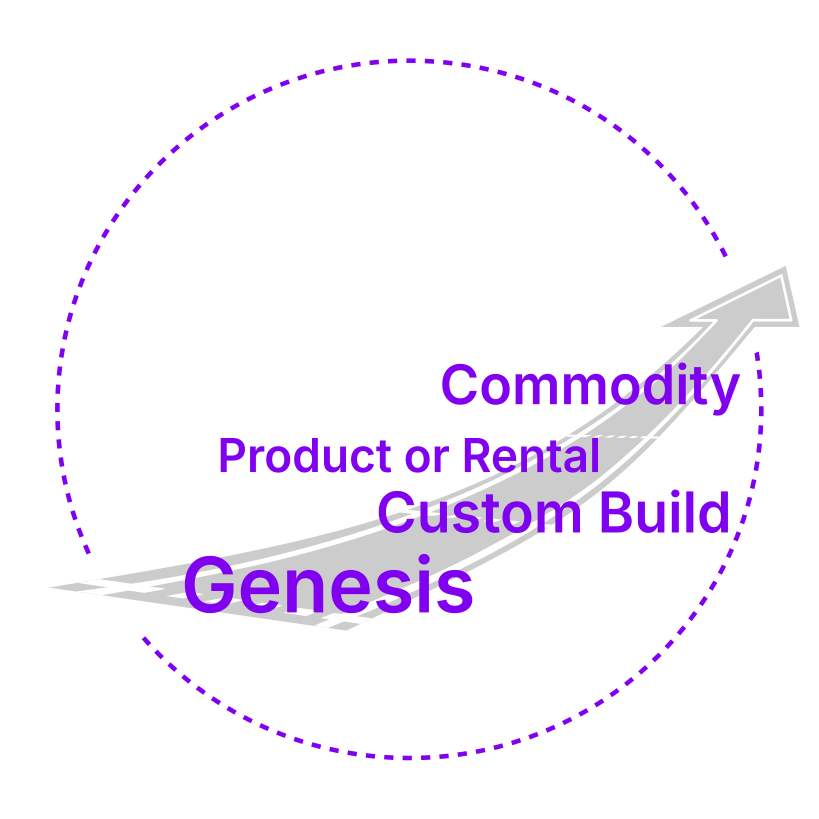
In 2024, when I started writing this book, I conceived the idea of an AI writing assistant to support my writing process in my preferred markdown editor. My idea was in its Genesis stage on the evolution scale of Simon Wardley. I soon discovered that others had similar ideas, and some had even developed plugins for my writing app. However, these plugins fell short of my specific needs. I decided to develop my own plugin, leveraging a coding assistant based on a Large Language Model. This led to the birth of my Custom Built solution, which I called “AI Writing Assistant.”
Reviewing these lines in early 2026, they already sound outdated. I have replaced my writing app with an armada of AI agents, scripts, and plugins. My agents now have self-learning mechanisms and improve themselves (described in AI Agents in Practice Beyond Coding). Still, it remains a Custom Built solution, specific to my work as consultant, writer, and Co-CEO of my own company.
By the time you read this, your Apple device, Google Cloud services, or even your smartphone may already have integrated assistants far smarter and more capable than mine. That will present a challenge: maintaining my own solution to keep up with state-of-the-art functionality costs me time and prevents me from focusing on what I really want, writing about AME3. At least that is what I tell myself. The truth is, I love coding too much to stop.
It is even likely that the way we interact with software products has entirely changed by then. Software interaction is evolving from tools we operate to agents that act on our behalf. The applications you use today may no longer exist as separate products. They may have been absorbed into AI agents that understand your situation and act before you ask.
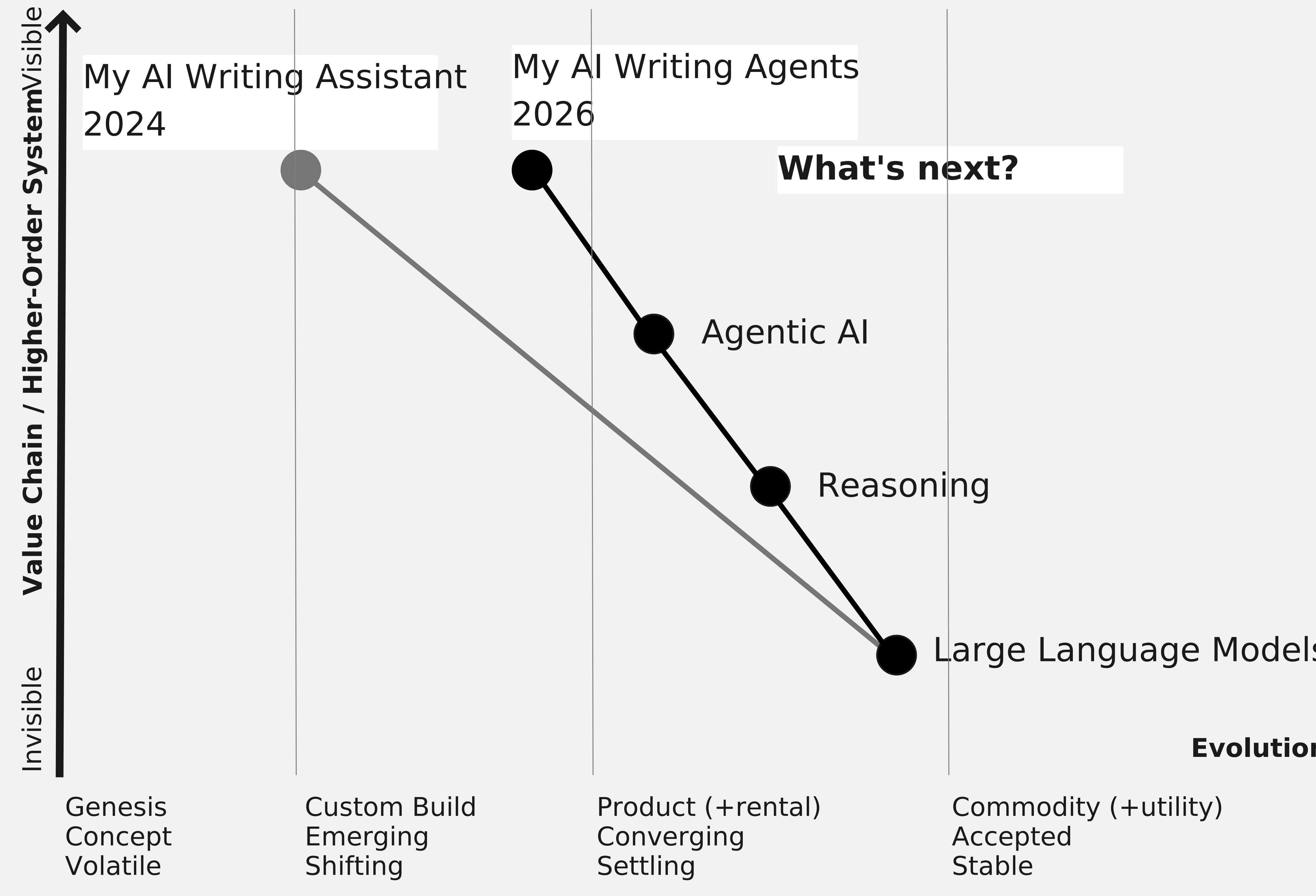
So what are my options now with my AI writing agents and assistants? I could work harder or code more efficiently, the most common improvement strategy. But focusing on an evolution strategy would bring me to a much higher level of innovation. I foresee two possible paths.
First, I can invest in changing my writing process and switch to an existing Product that I can buy or rent. I outsource parts of my writing process because the product adds more value than the money I spend. Alternatively, I have the option to offer my solution as a product, publishing it as open-source, enabling others to use and contribute to it.
AI-based writing assistants will become a Commodity. We will integrate these tools into our workflow as seamlessly as we use water or electrical energy. Until then, many AI products and services will emerge and disappear from the market. As customers, we will experiment with them and over time establish a standard for their integration into our daily lives, the same way we once did with pen and paper. The decisions for your products and services today are creating the challenges of tomorrow.
Evolution at Enterprise Scale
My AI writing assistant is a small example. Let me share a larger one.
At Web.de, at the time one of the largest internet portals in Germany, I experienced this evolution firsthand. Web.de served roughly 80% of all German internet users. Millions had an account and used the mail service daily. The customer base was growing exponentially, driven by broadband adoption, and new technologies were rising even faster.
The computing and network infrastructure that my colleagues maintained one floor below, where I was developing the services, filled several machine rooms with thousands of servers. Dedicated teams managed servers, storage, and network equipment around the clock. This infrastructure was Custom Built: designed, assembled, and operated specifically for Web.de’s services. It was expensive, it required specialized knowledge, and it was the foundation everything else depended on.
More than twenty years later, that complete computing infrastructure is something I can rent within seconds from any data center in the world. What once required dedicated teams and physical hardware has become a Commodity, available on demand at marginal cost. Simon Wardley documented this pattern across the entire history of computing infrastructure.
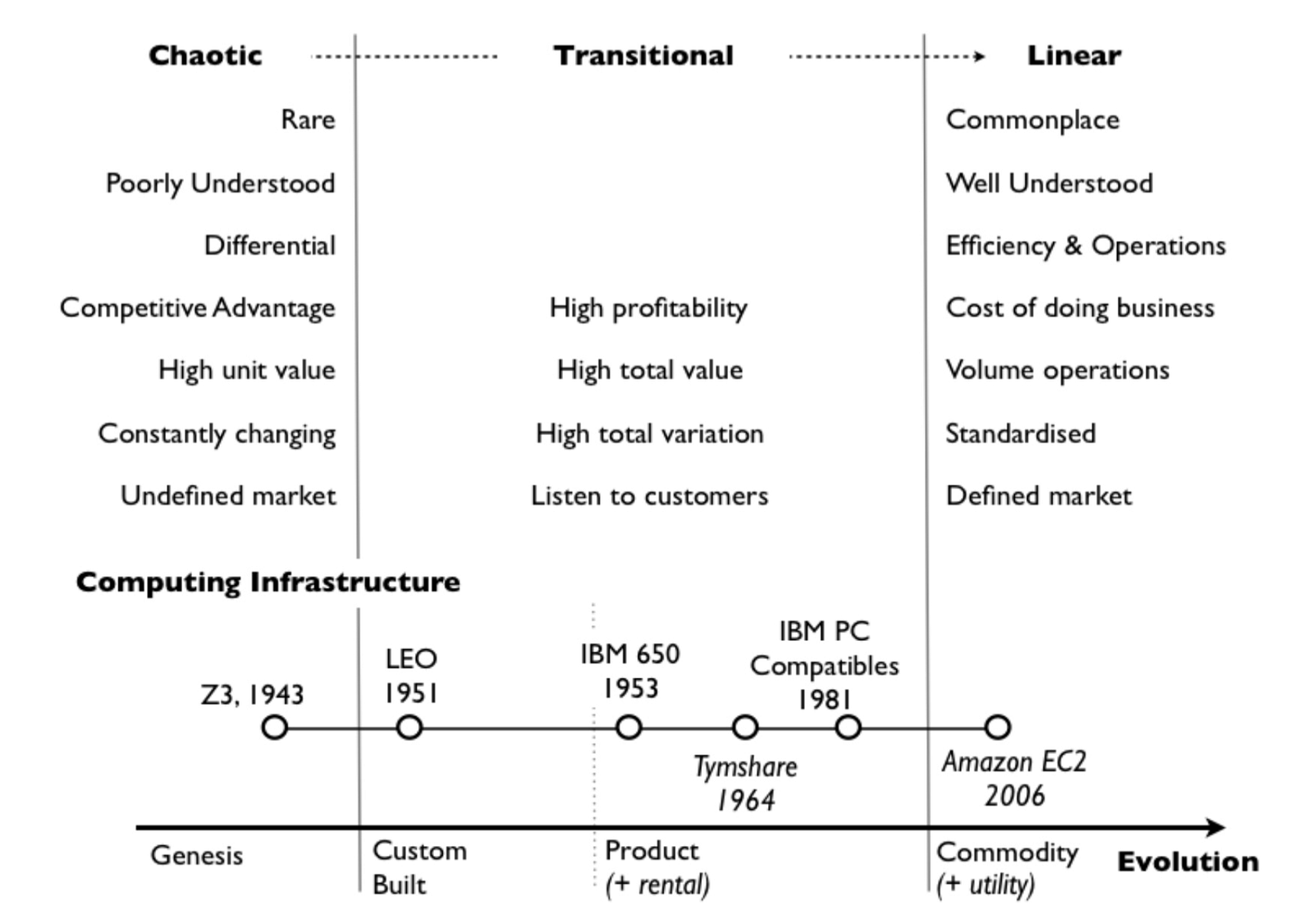
This is the evolution path that all products and services follow. Wardley describes four stages: Genesis (novel, uncertain, requires exploration), Custom Built (understood enough to build for specific needs), Product (mature enough to offer to a broader market), and Commodity (standardized, available as utility). My AI writing assistant and Web.de’s computing infrastructure are examples of the same force at work, at very different scales. Every Enterprise navigates this path with every product and service it offers.
A Universal Principle
Evolution is not limited to technology or software. As explored in AI and the Principles of Evolution, it is a universal principle: every major technology, from the printing press to electricity to the internet, led to greater complexity, not simplicity. Our products and services follow the same pattern. Their components and parts will continue to advance as long as our society invests energy in our markets.
Evolution is not a constant flow. Tushman and O’Reilly showed that organizations evolve through periods of incremental change punctuated by discontinuous, revolutionary change (Ambidextrous Organizations). The development of Artificial Neural Networks illustrates this pattern vividly. There was a long period, known as the AI winter, where innovation was stagnant. Then, with the availability of vast amounts of data, computing power, and substantial investment capital, progress accelerated dramatically. Enterprises must be prepared for both: long stretches of steady evolution and sudden disruptions that reshape entire industries.
The evolution of any individual component like a Large Language Model can take decades. But Wardley identifies a pattern that changes the picture: the evolution of communication increases the speed of evolution overall. Every advance in how we share knowledge, from the printing press to the telephone to the internet, compresses the cycle for everything that builds on top of it. AI is the latest and most powerful step in this sequence.
What makes the current moment feel different is that multiple evolutionary waves now overlap. AI, robotics, biotechnology, and energy transition each follow their own timeline, but together they create an environment where disruptive change arrives from many directions at once. In the early part of the last century, the span of disruptive innovation often exceeded an engineer’s career. Now, as an engineer over 50 years of age, I find it challenging to count the groundbreaking innovations I have had the privilege to witness. We cannot stop evolution. It is in human nature. But we can lead it.
Agility and Efficiency Are Not the Goal
Evolution does not stop at the product. Every shift along the evolution path changes how we need to work. A Team exploring a novel idea in the Genesis stage needs freedom to experiment, fast feedback, and the ability to pivot. A Team operating a Commodity service needs reliable processes, consistent quality, and operational stability. The product evolves, and the work system must evolve with it.
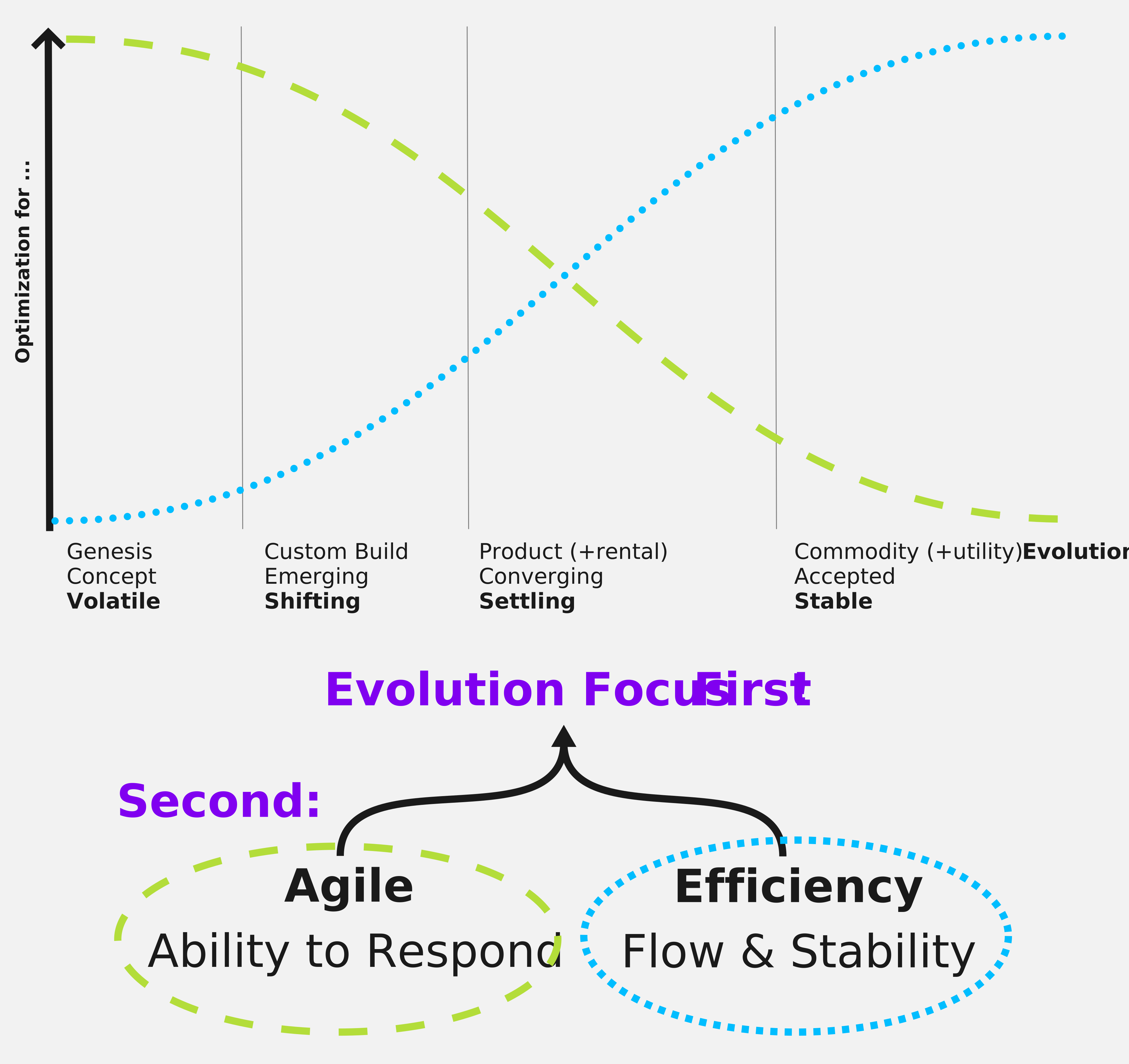
This is why many organizations get stuck when they pursue agility or efficiency as their primary goal. These are valuable, but they are lower-order goals. As the image shows, agility (the ability to respond) matters most in the early evolutionary stages: Genesis and Custom Built. Efficiency (flow and stability) matters most in later stages: Product and Commodity. A water utility delivering commodity services should optimize for consistent quality and reliable delivery, not for agility. A startup exploring a novel idea should optimize for learning speed, not for efficiency. However, most organizations operate somewhere in the middle, with products and services at different evolutionary stages simultaneously. They must balance both agility and efficiency, applying each where it fits.
Different parts of the organization sit at different evolutionary stages. They require different optimization strategies, and therefore different designs for their work systems. Only an evolution-based approach reveals which balance is right and where to focus. Agility and efficiency are consequences of making the right evolutionary choices. They are tools that serve different phases, not ends in themselves. The question is not “how efficient are we?” or “how agile are we?” but “how well do we navigate evolution compared to our competitors?”
Reorganization as Standard Practice
Whenever we advance our products and services along the evolution path, reorganization becomes necessary. New products in the Genesis stage need small, cross-functional Teams with the freedom to explore. As products mature into Custom Built solutions, Teams grow and specialize around stable boundaries. When products become Commodities, the organization must shift toward operational efficiency, or consider outsourcing entirely. Each transition changes team structures, leadership responsibilities, and the methods that work best.
While this may seem dramatic, it is standard practice within an AME3 organization. Maintaining flexibility is embedded in the Rules and the Agile and Lean methods we employ. Understanding the evolutionary phase of the Arena Product guides Teams and their System Leads in selecting the most appropriate methods and frameworks.
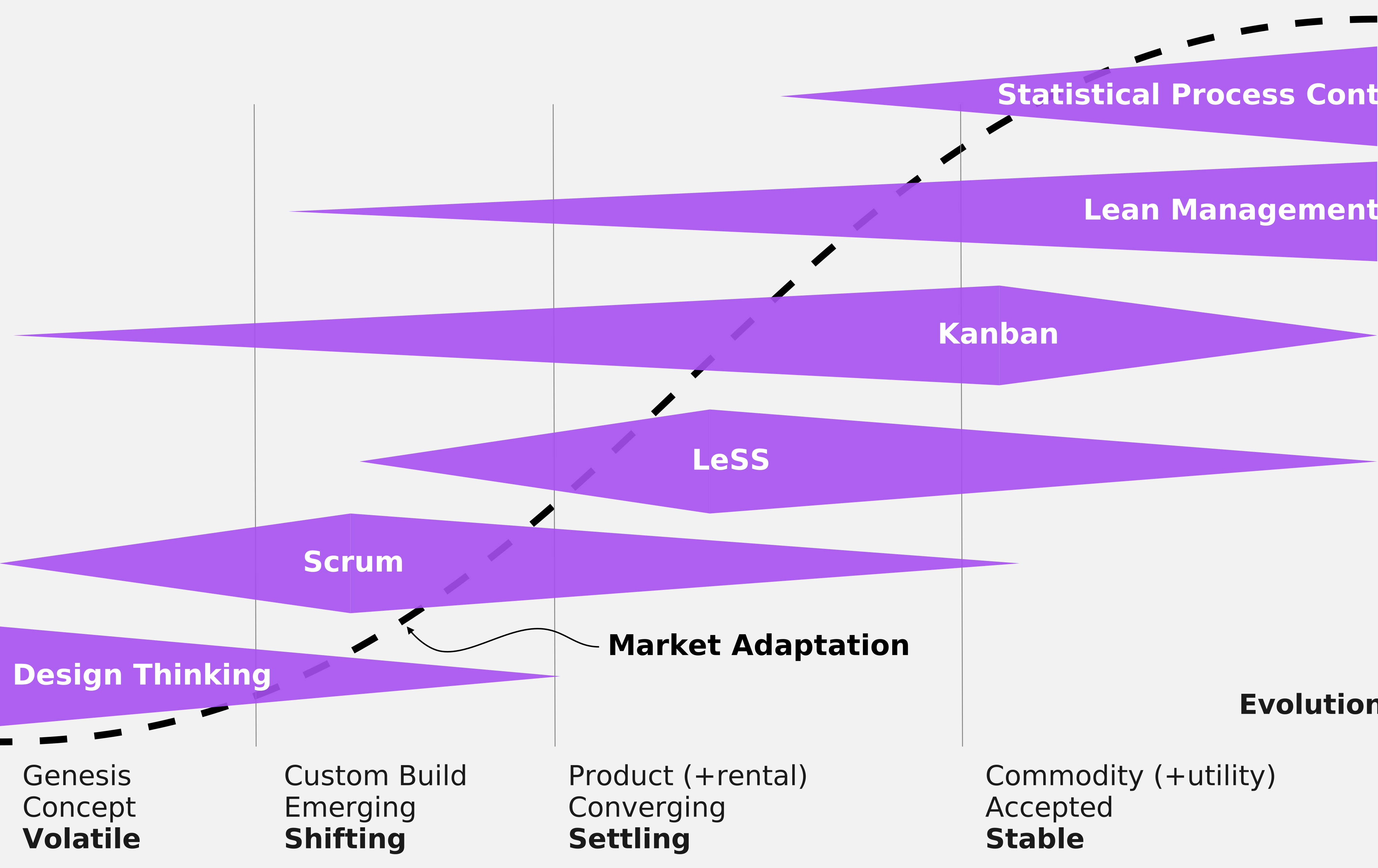
Evolution Focus is a strategic doctrine in AME3, exercised through the co-creation process with the experts in the Teams, the Arena Owner and Enterprise Owner, facilitated by the System Leads. It is not a one-time assessment but a continuous practice, revisited in every Tournament as Accountable Representatives assess where the Enterprise Product sits on the evolution path and where to direct energy next.
The Third Doctrine
Evolution Focus completes the strategic foundation of AME3. Where Empirical Control establishes the mechanism for learning and Overall Optimization ensures that learning benefits the whole, Evolution Focus answers the deeper question: what should we be learning about, and where should we direct our energy?
Without Evolution Focus, enterprises risk optimizing in the wrong direction. They may become highly efficient at producing something the market no longer values. They may become highly agile at responding to change without understanding which changes matter most. In evolutionary biology, the Red Queen Effect describes this dynamic: organisms must constantly evolve just to maintain their relative fitness against co-evolving competitors. Enterprises face the same pressure. Standing still is not an option when competitors, markets, and technology evolve around you.
Evolution Focus ensures that Teams, Owners, and System Leads make informed decisions about innovation, outsourcing, and organizational design based on where their products and services sit on the evolution path.
Together, the three doctrines create a self-improving system:
- Empirical Control answers: How do we know if we are improving?
- Overall Optimization answers: Who benefits from the improvement?
- Evolution Focus answers: What should we be improving?
The next section, Leadership, explores how AME3 structures the leadership functions that bring these doctrines to life.