The Leadership System
The Essence of Leadership
You might be familiar with this scenario: A young girl, possibly around five years old, stands in line with her father at a supermarket checkout. She is captivated by one of the enticing offers placed at her eye level. With wide, pleading eyes, she turns to her father and asks, “Can I have that pleeeeaaase?”.
Yes, I was the father in that story, and my response was: “OK, but let’s keep it a secret from your mother.”
The scene took place in 2006. At the time, I was deeply reflecting on the meaning of Agile Leadership. A term gaining traction in the business world at the time, as many other “old” terms did by adding Agile before them. In the parking lot, it struck me: what had my daughter actually done? She used her voice and body language to lead me to a decision that served her goal.
So, she was actually leading me. I felt ashamed because, as a father, I expect myself to lead my children in making wise decisions and selecting healthy options.
But, thanks to my daughter, I found for myself a definition for the term leadership at this moment. It sounds trivial. But the mechanism is universal: Leadership is essentially the way to move others toward decisions that serve a greater goal.
There are many ways to do this. My daughter’s way can perhaps be described as the big-eye method. Command and control or servant leadership are others. All have their place and belong to the collection of leadership practices.
The story also told me that leading people happens all the time, every day, by everyone. By writing these words, I am leading you to insights that will help you make decisions for yourself and your business.
Every team member leads, whether they intend to or not. If someone backs down when discussing a decision (perhaps because they shy away from conflict), they lead to a decision. Even if they do not support this decision.
Leadership is ever-present and inherent; it does not need to be implemented. Leadership ends with the suffix -ship, like in mastership, and denotes the way things are done. Thus, discussing leadership is essentially discussing our methods of leading.
You cannot not lead. – Inspired by Paul Watzlawick
What Is Agile Leadership, and Why Do We Need It?
Returning to the concept of Agile Leadership, it highlights the necessity for a distinct understanding of leadership to establish and maintain an agile organization. Let us explore this further.
In 2001, a small group of people defined values and principles for software development and recorded them in the Manifesto for Agile Software Development. This set of values and principles is generally credited with popularizing Agile in the working world. For the authors, the term Agile mainly expressed why they would work according to these values and principles.
Software development has had to react to the ever-faster-changing market and technology development. Other domains today, such as software development in 2001, are facing a similar challenge. Digitalization, Industry 4.0, Generative AI, and new work are just some of the buzzwords. Agile is, therefore, an optimization goal for the organization. A very brief definition: Agile is the ability to respond to change.
So, to summarize, we can say: Agile leadership is the way to lead others in making decisions facing a rapidly changing environment, adhering to the values and principles of the Agile Manifesto.
But how do you get this kind of leadership up and running in your enterprise? The answer is, you need a system embedding this way of leadership.
What Is a Leadership System?
Simply put, if we accept that you cannot not lead, all social groups operate as leadership systems. Recognizing this, the term leadership system implies that to achieve a specific leadership style, we must create the appropriate system that allows that leadership to thrive.
So, to be an agile leader, you must first develop such a system and live it yourself. AME3 can help you.
How Does the Leadership System Work within AME3?
AME3 sees itself as a framework. As such, it defines a skeleton with three functions, their fundamental responsibilities, and the constraints on which the system can work. It intentionally does not offer a complete operational model. This approach allows the system to evolve and adapt over time.
The Rules are based on decades of observation of Agile organizations by a large community. One member of this community, Nigel Baker, would rate them at the highest level on his Nigel Scale: core practice, something you must do no matter what. Just as a surgeon always disinfects their hands before entering the operating room without questioning it.
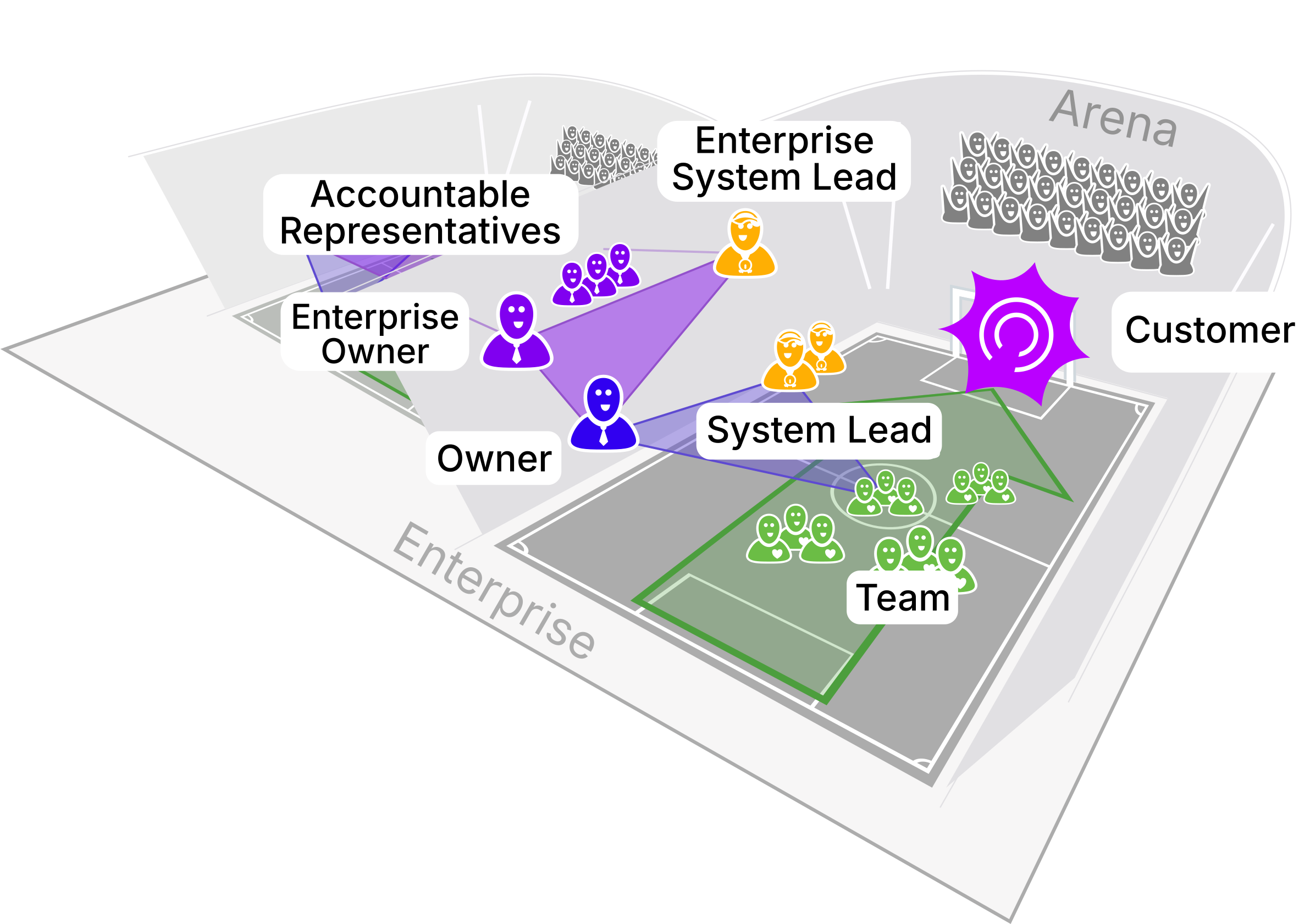
Viewed together, the functions form a leadership system that resembles a triangle of forces. This system is stable enough not to swing to the extreme if one force gets out of hand. This addresses the enterprise’s need for control.
On the other hand, designing a system based on only three forces maximizes agility by minimizing delays caused by waiting for others during decision-making. This approach addresses the need for high flexibility in continuously changing environments, such as dynamic markets.
In other words, AME3 forms a system of checks and balances. It is stable and self-regulating, yet with maximum adaptability. Such triangles of forces have proven their worth in social systems many times, e.g., in governing a state: legislation (legislature), executive power (executive), and jurisdiction (judiciary). Or in running a football club: team, coach, and club president.
The Leadership Functions in a Nutshell
The Leadership System of AME3 is fundamentally composed of three key functions: Owners, System Leads, and Teams.
System Leads lead to an effective work system. They serve the enterprise by:
- Developing competencies of Teams and people.
- Facilitating decision-making.
- Sustaining a continuous cycle of Anticipate, Advance and Assess.
Owners lead to the success of the product and services. They serve the enterprise by:
- Balancing opportunities and risks.
- Focusing the organization to increase effectiveness.
- Ensuring decisions are made.
Teams lead to customer satisfaction. They serve the enterprise by:
- Managing and executing the work.
- Creating value and ensuring quality.
- Identifying opportunities for improvement in products, services, and work systems.
Conclusion
My daughter led me to buy her a treat at the supermarket checkout. She used exactly one method: big eyes. It worked, but it was not a system. An enterprise needs more than charm and good intentions. It needs a structure that channels leadership where it matters.
AME3 provides that structure with exactly three functions: Owners lead to the success of products and services, System Leads build the work system that enables effective delivery, and Teams lead to customer satisfaction. Three forces, not more. Enough to create stability through checks and balances, few enough to preserve the speed of decision-making.