The New New Enterprise Game
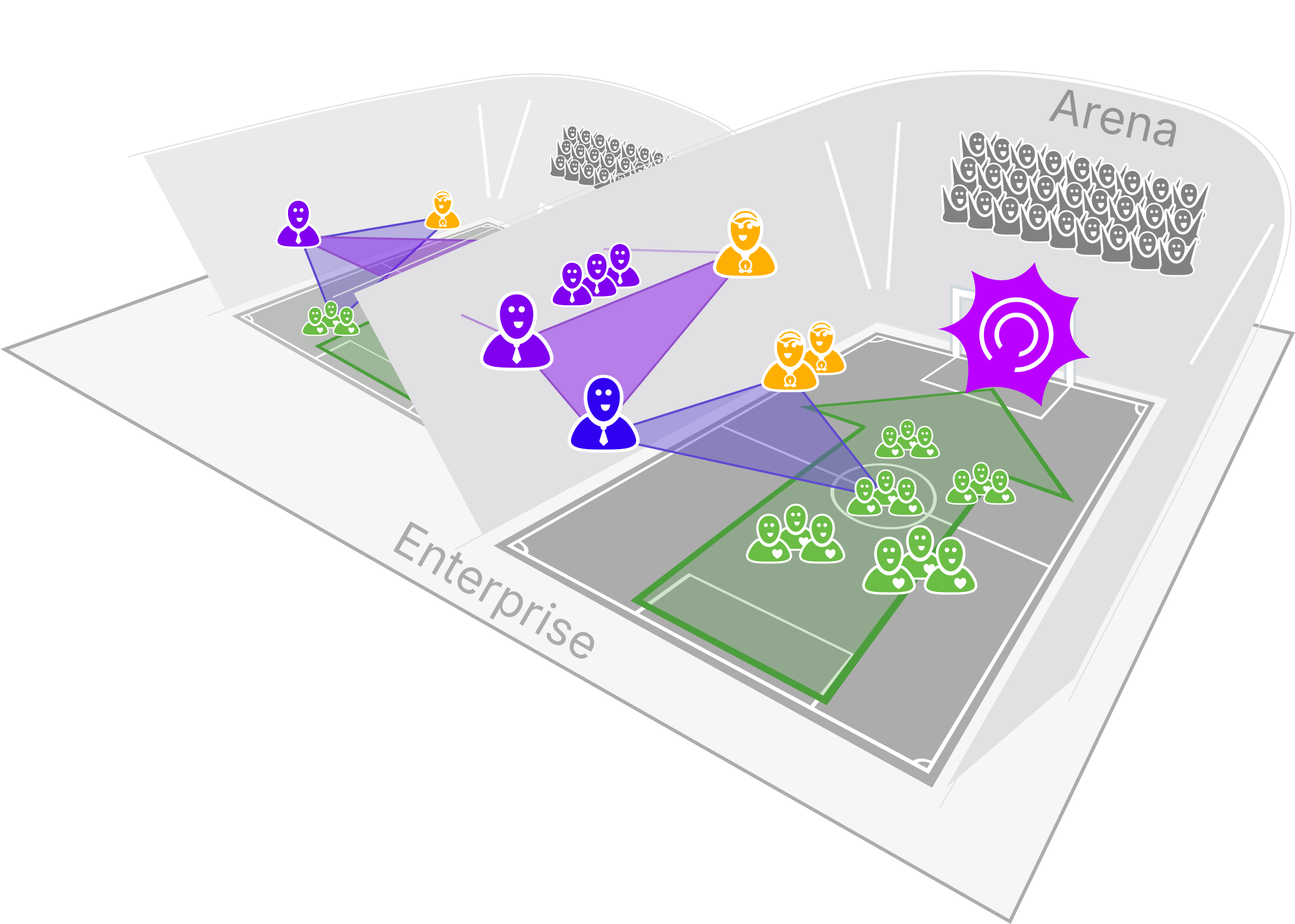
In 1986, Hirotaka Takeuchi and Ikujiro Nonaka published The New New Product Development Game, an article that would profoundly influence how the world thinks about product development. Their insight was simple and powerful: small, cross-functional teams that work in overlapping phases outperform sequential, relay-race approaches. Speed, flexibility, and learning are built into the team, not managed from above.
This insight gave birth to the Agile movement. Frameworks like Scrum and eXtreme Programming helped software teams adapt to rapidly changing environments. Kanban and Lean brought the focus on flow, limiting work in progress, and eliminating waste. These methods proved that empowered teams could deliver better results, faster. Countless organizations saw it work.
Then companies tried to scale these methods. With frameworks such as Scrum@Scale, SAFe, and LeSS, they pushed agility into larger parts of the organization. Yet the agile areas remained isolated, incompatible with the standard operation of the enterprise.
At best, agile teams were tolerated as eccentrics. At worst, they deepened the very silos they were meant to dissolve. More and more companies are now backing away from “Big Agile.” It simply did not work for them.
The problem was never that agile methods lacked effectiveness. The problem was the absence of a compatible operating system for the entire enterprise. One that evolves with the company and integrates the principles that make agile frameworks powerful.
The Agile movement also had to learn that flexibility and adaptability alone are not what enterprises need. They must optimize for efficiency and stability as well. The real challenge is doing both at the same time. The answer lies in focusing on evolution, governed by empirical control.
It is now time to bring this game to the entire company. Welcome to The New New Enterprise Game. AME3 builds on the heritage of Agile and Lean to create an operating model for the evolving enterprise.