Wardley Mapping
Wardley Mapping is a strategic decision-making framework created by Simon Wardley. It combines visual mapping of value chains with an understanding of how components evolve over time, giving leaders a shared language and a shared picture for strategic conversations.
This article introduces the key concepts: the map itself, the strategy cycle that surrounds it, climatic patterns, doctrine, and how Wardley Mapping connects to other strategic frameworks. For the practical guide on building your first map, see Building a Wardley Map: Step by Step.
The Map
A Wardley Map is a strategic visualization that depicts a value chain, from users and their needs down to the capabilities required to meet those needs. Components are arranged by dependency (vertical axis) and mapped against four stages of evolution (horizontal axis): Genesis, Custom, Product, and Commodity.
The vertical axis represents visibility: what the customer sees sits at the top, what is invisible but necessary sits at the bottom. The horizontal axis represents evolution: how mature, standardized, and well-understood each component is.
This simple two-axis structure reveals patterns that spreadsheets and PowerPoint slides cannot. You can see which components are commoditizing, where dependencies create risk, and where the next wave of innovation will come from. A map is always someone’s map: the perspective shapes what appears. And a map is always wrong the moment you draw it. Its value is not accuracy but shared understanding.
Inspired by military strategy principles from Sun Tzu’s Art of War, Wardley Mapping helps organizations understand who benefits from their work, what those benefits are, and the system of capabilities that deliver market success. The methodology is open-source.
The Strategy Cycle: Five Factors
Building a map is only one part of strategy. Simon Wardley, in his quest to comprehend strategy evaluation, discovered insights in military history and Sun Tzu’s Art of War. For Wardley, five elements encapsulated the essential considerations for strategic decision-making:

Purpose is the moral imperative, the reason the organization exists and the game it chooses to play. Without a clear purpose, strategy degenerates into reaction.
Landscape is the competitive environment depicted by a map. In a military setting, a physical map serves as the foundation for understanding the landscape. In business, the equivalent is a Wardley Map: a visual representation of the value chain and the evolutionary stage of each component. Without a map, you are navigating blind.
Climate describes the external forces that act on the landscape regardless of your actions. These are the climatic patterns: everything evolves, there is no single choice (components can follow multiple paths), characteristics change as components evolve. You cannot stop the climate, but you can anticipate it.
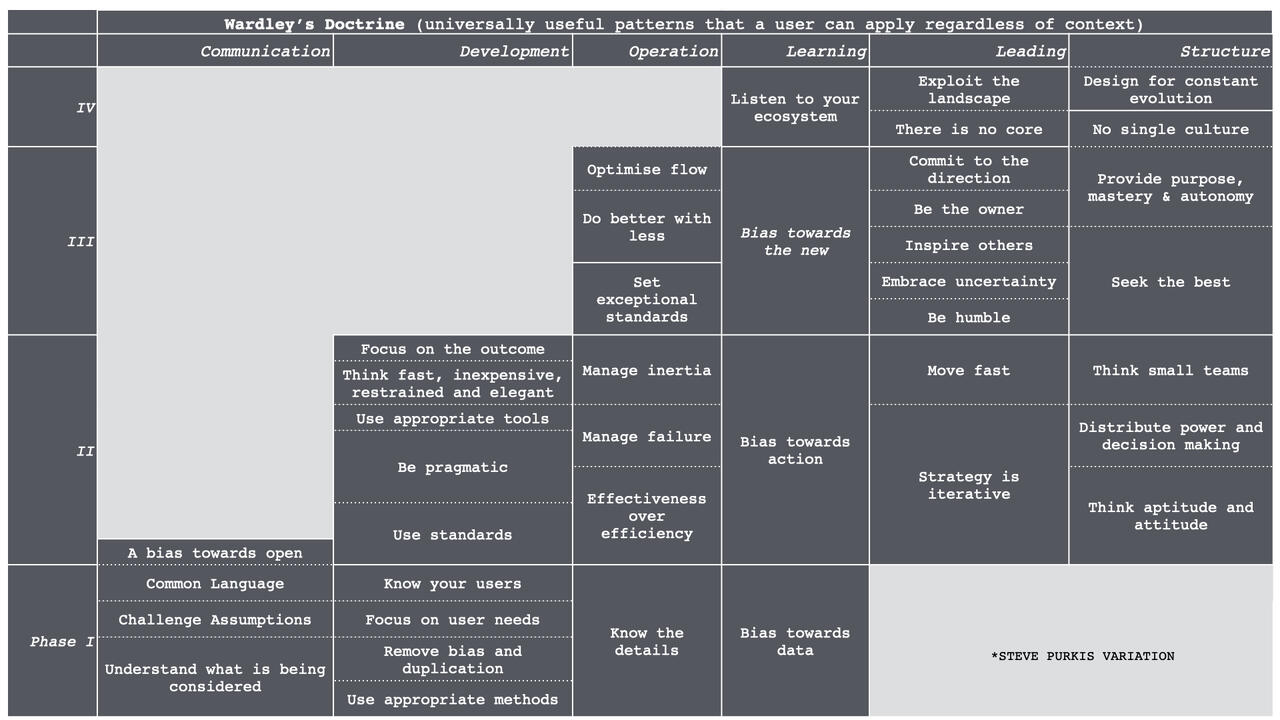
Doctrine is the set of universally applicable principles that guide how an organization operates: use a common language, challenge assumptions, focus on user needs, think small, be transparent. Good doctrine does not depend on context. It works everywhere.
Leadership is the context-specific choices: the gameplay, the strategic moves you make given your purpose, landscape, climate, and doctrine. Leadership is where strategy becomes action.
These five factors form a continuous cycle. You revisit purpose, redraw the landscape, reassess climate, strengthen doctrine, and make leadership decisions. Then you do it again.
Climatic Patterns
Climatic Patterns are recurring forces or trends in business environments that shape the evolution of components within a value chain, regardless of individual actions. They are the weather on your strategic landscape: you cannot control them, but you can prepare for them.
Examples of climatic patterns include:
- Everything evolves through supply and demand competition. No component stays in Genesis forever. Competition drives evolution from Genesis to Custom to Product to Commodity.
- Characteristics change as components evolve. What works in Genesis (experimentation, high failure tolerance) is wrong in Commodity (efficiency, standardization). Organizations that apply Genesis thinking to Commodity components waste money. Organizations that apply Commodity thinking to Genesis components kill innovation.
- There is no single choice. Components can take multiple evolutionary paths. A technology can become a product or a utility or both simultaneously. Strategy must account for these branches.
- The past success trap. The practices that made an organization successful in one evolutionary stage often prevent success in the next. Resistance to change is not irrational: it is a rational response to past evidence. But the evidence is no longer valid.
These patterns include economic shifts, technological advancements, and competitor behaviors that drive change and influence strategic decisions. Understanding them is what separates strategic thinking from guessing.
An overview of all climatic patterns can be found here.
Doctrine
Doctrine refers to a set of universally applicable principles that guide decision-making and actions within an organization. These principles are not specific to any particular context but are meant to be broadly applicable across various situations. Wardley’s doctrine emphasizes the importance of understanding the landscape, anticipating changes, and adapting strategies accordingly.
Doctrine is organized into categories such as communication, development, operation, learning, leading, and structure. It provides a comprehensive checklist for assessing organizational maturity. Where are you strong? Where are you weak? The assessment is often uncomfortable, and that is the point.
Key doctrine principles include:
- Use a common language. A map is useless if people cannot read it together.
- Challenge assumptions. What you know to be true may no longer be true.
- Focus on user needs. Not your technology, not your org chart: the user.
- Think small. Use small teams, small contracts, small steps. Break large problems into small ones.
- Be transparent. Share maps. Share assumptions. Share what you do not know.
- Use appropriate methods. Genesis requires experimentation. Commodity requires efficiency. Using the wrong method for the evolutionary stage is a common and expensive mistake.
The Strategy Cycle and OODA
Wardley’s strategy cycle combines John Boyd’s OODA Loop (Observe, Orient, Decide, Act) with Sun Tzu’s five factors of strategy. The result is a framework that transforms decision-making from reactive to systematic by emphasizing situational awareness and continuous learning.
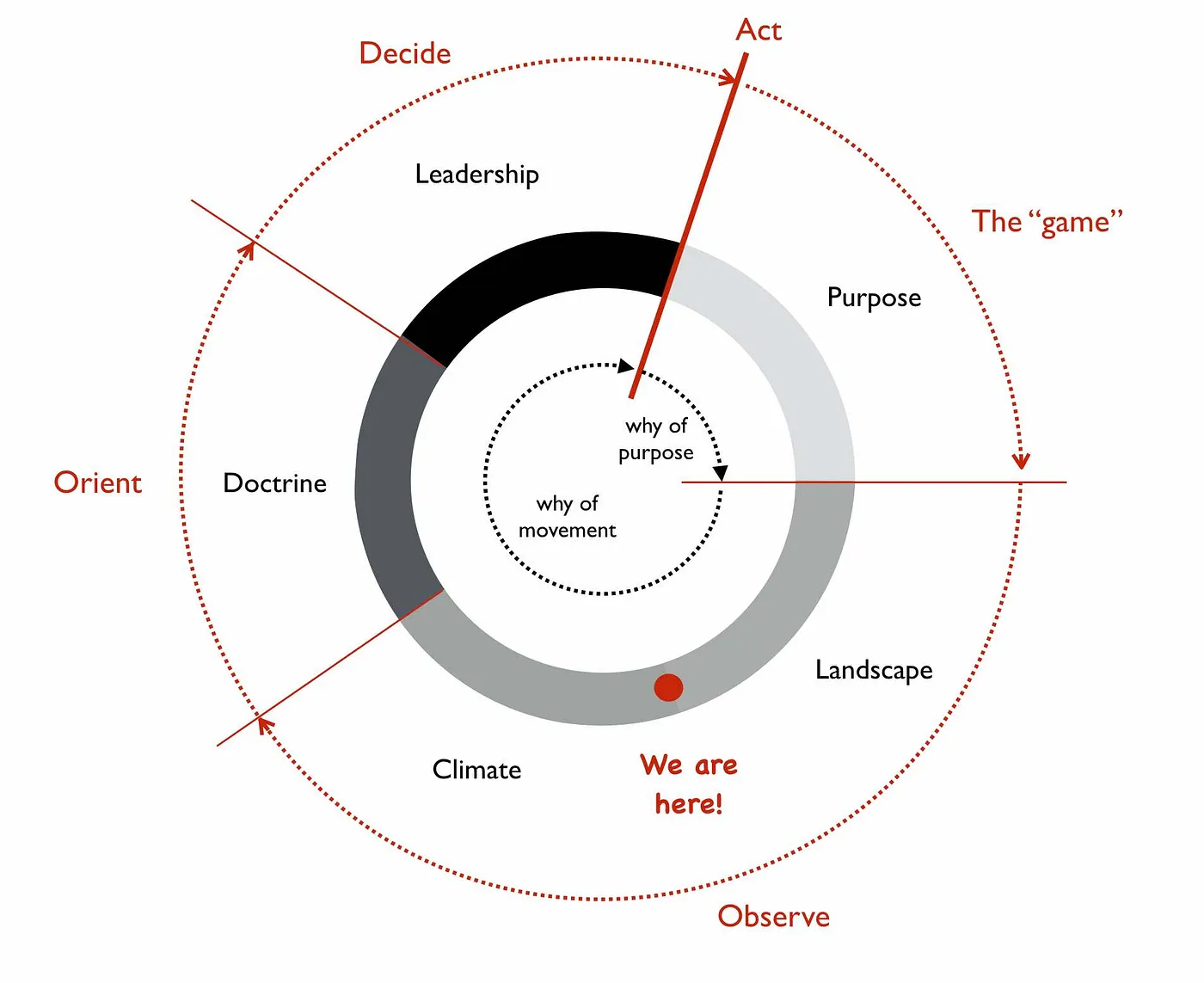
The OODA loop addresses a common failure mode: staying stuck in execution without reassessing whether the solution addresses the right problem. Organizations that only Act without re-Observing accumulate strategic debt. They build faster while running in the wrong direction.
Wardley Maps serve as visual tools in the Orient phase: they connect observations to strategic decisions. When you observe a market shift, the map helps you orient by showing which components are affected, which dependencies are at risk, and where opportunities emerge. The decision and action phases then have a foundation in shared situational awareness rather than individual intuition.
The cycle is continuous. Each action changes the landscape. Each change requires new observation. Strategy is not a plan you execute. It is a loop you maintain.
Wardley Maps and Cynefin
Wardley Maps and the Cynefin framework are complementary but distinct. Simon Wardley is explicit on this point: the two should not be combined into a single holistic view. They provide different perspectives on the same territory, and their value lies in the tension between those perspectives.
A key insight from Wardley’s analysis: while Wardley Maps represent different stages of evolution, Cynefin terms like “complex” and “complicated” cannot be directly mapped onto these stages. A component in the Product stage is complicated (many parts operating in a defined manner), but the problem space of choosing the right product may still be complex (the “right” solution is still emerging). Within a single pipeline, you can have multiple complicated solutions to a complex space.
Whilst each system is complicated (having many components operating in a defined and known manner), the “right” solution is still emerging. This means the problem space itself is complex.
Both frameworks should be used in tandem to provide diverse viewpoints. Use Wardley Maps to understand where things are and where they are going. Use Cynefin to understand what kind of problem you are dealing with and what approaches are appropriate. The map tells you the terrain. Cynefin tells you what kind of ground you are standing on.
Connection to AME3
Wardley Mapping integrates naturally with AME3’s strategic layer.
Evolution Focus is one of AME3’s core doctrines. It draws directly on Wardley’s insight that components evolve from Genesis to Commodity and that strategy must account for where each component sits on this path. The Enterprise uses Wardley Maps to understand its competitive landscape and to identify which parts of the Enterprise Product are evolving, which are commoditizing, and where the next strategic bets should be placed.
Empirical Control aligns with the continuous nature of the strategy cycle. Each iteration through the Observe-Orient-Decide-Act loop generates new evidence. Maps are redrawn. Assumptions are tested. The Tournament provides the cadence for this reassessment.
Doctrine and AME3 Principles share the same intent: universally applicable guidelines that do not depend on context. Wardley’s doctrine principles (use a common language, challenge assumptions, focus on user needs, think small) echo throughout AME3’s own principles and rules.
The practical companion to this article, Building a Wardley Map: Step by Step, walks through the mechanics of building a map from scratch. Start there for the hands-on experience.
References
- Wardley, S. Wardley Maps: On Being Lost. medium.com/wardleymaps
- Wardley, S. Exploring the Map. medium.com/wardleymaps
- Wardley, S. Wardley Maps and Cynefin. swardley.medium.com
- Learn Wardley Mapping (climate patterns, doctrine assessment tool)