Why Outevolve
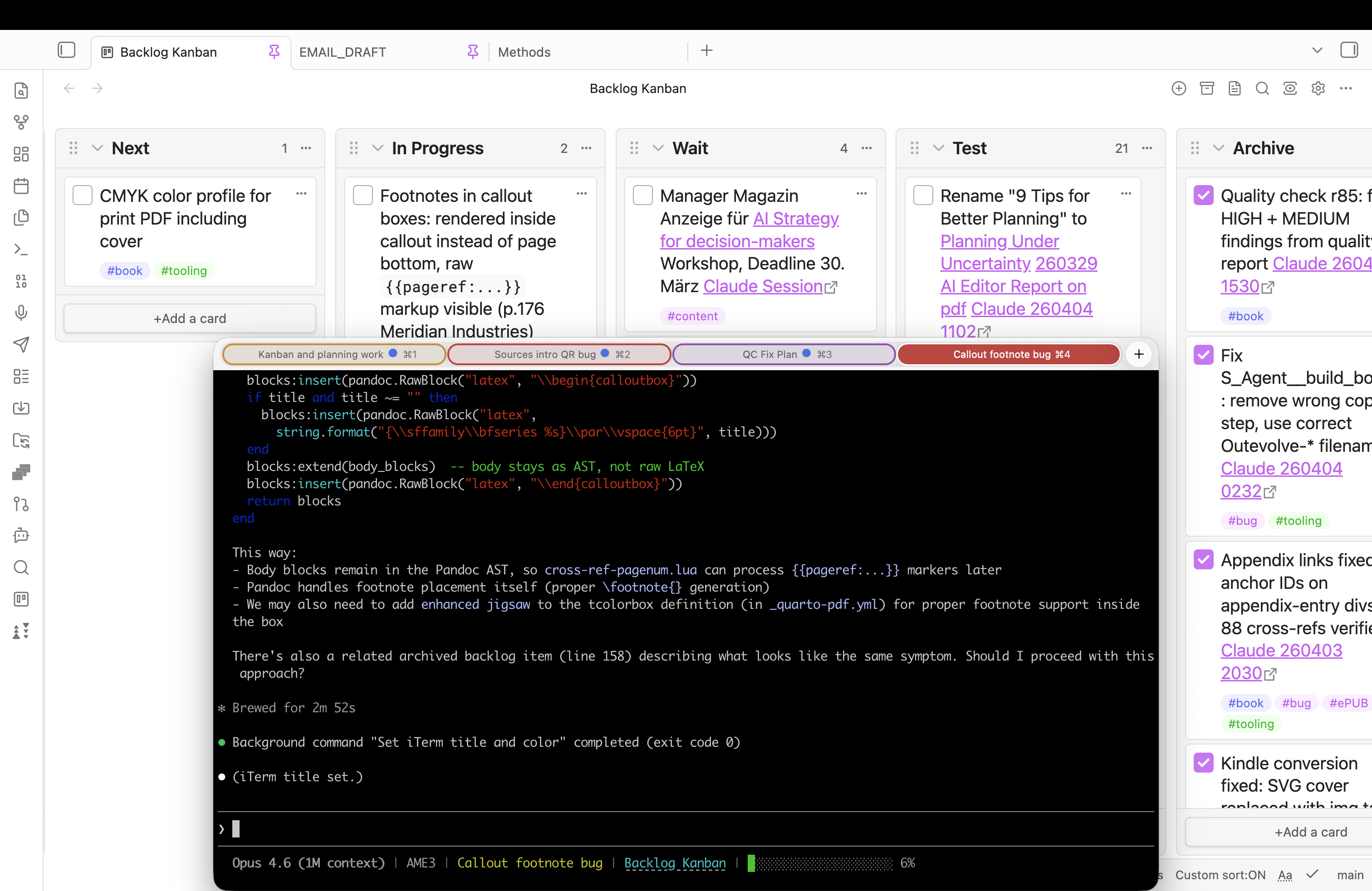
It is March 2026. Andy shares his screen from Bremerhaven, 700 kilometers away. An AI coding agent is creating training material for his class next week in Vietnam. On my screen, another agent is evaluating his feedback on this book, sorting tasks and issues into my Kanban board. We are talking, and the agents are working. This is how Andy and I work now: two people, an armada of AI agents.
But this book is not about that. It is not about how two consultants organize their work with the latest AI technology. It is about the opportunities AI opens up, the way it is shifting markets, and what this means for your enterprise. Your products. Your services. Your organization. And your strategic answer.
Andy and I have been here before. Not with AI, but with the forces that came before.
In 2003, Andy hired me as a software developer at Web.de, one of the first and largest web portals in Germany. Internet services were young. Most companies in Europe did not believe this technology would change their business entirely. The situation was not different from AI today.
It was there that we both discovered Scrum for the first time. We used it as a lightweight method to organize our highly innovative and sometimes chaotic work. It worked. Small, empowered teams delivering results in short cycles, adapting to a market that moved faster than any plan could follow.
Seven years later, in 2010, Andy and I founded DasScrumTeam. Our goal was not only to help organizations use Scrum to improve their products and processes. It was also to run our own company the way we thought the future works. Virtual. Distributed. Lean. An organization built from the ground up on the principles we were teaching others. We were a distributed company running our business online long before anyone was forced to be. By 2019, we had grown to twelve employees and worked with nearly twenty independent trainers and consultants.
Today, our core business has entirely changed. Organizations that used to send twenty people to a three-day classroom training now onboard new employees with AI-powered platforms in a fraction of the time. The shift from classroom to digital to AI-enhanced learning happened faster than our strategic map predicted, and we had seen it coming for years. Still, it is overwhelming when a strategic prediction actually happens. What kept us going is our focus on the new: innovative topics, genesis-stage ideas, and the willingness to reinvent what we do before the market forces us to.
We could have used AI to scale what we already did. Deliver more training, faster, cheaper. That is one path: use AI to accelerate what you already do. Investing in efficiency can be a smart strategic move. But the danger is doing it without questioning the direction. An efficient organization becomes even faster at delivering products and services customers no longer want. A bureaucratic organization generates more bureaucracy at machine speed.
The other path: use AI as a catalyst to rethink what your enterprise does and how it is organized. Andy and I chose this path. We stopped scaling a training business and started building something new: new frameworks, new formats, and this book. We stripped away what no longer served us and redirected our energy toward where we saw the market heading.
There is a fork, and it determines what game your enterprise is playing. Keep playing the old game with the old tactics and hope they still work. Or change your game. Most enterprises will choose the old game without realizing it.
But AI is only one force among many. Talent shortages are hitting every sector. Regulatory burden is growing, not shrinking. Supply chains stretch across continents, fragile and exposed to geopolitical shifts. These challenges are not new individually. What is new is the pace. Changes that once took a decade now unfold in years. Multiple pressures hit simultaneously. And each one demands a different response: speed here, stability there, innovation in one area, efficiency in another.
No single design can hold all of this at once. What it requires is a different kind of operating model. One designed not for stability or agility alone, but for evolution.
The real strategic question is not “Are we doing AI?” It is not “Are we agile?” or “Are we efficient?” It is: How well does our enterprise navigate evolution compared to our competitors?
This is what it means to outevolve.
Andy and I drew on decades of experience in enterprise transformation, insights from the global agile and lean community, and research into strategy, organizational design, and complex systems to develop AME3: the Adaptive Metaframework for Empirical Enterprise Evolution.
The forces shaping your enterprise will not stop when AI matures. They will intensify. What you need is not a response to this moment but an operating model that keeps working as the world around you changes.
What follows is a guide to playing a different game. A game where we do not just adapt. We outevolve.